A Practical Guide to Doing, Writing, and Defending a CHAT Thesis
by Dr. Seanan Clifford
About this handbook
This handbook focuses on how to do a CHAT thesis — how to move from a messy situation to a defensible analysis. A single fictional case study (NorthCare NHS Trust) is used throughout to show how each step works in practice. While the case is invented, the problems it represents are typical of CHAT research in organisational settings. The handbook is intended to be used alongside the core literature, not in place of it.
What Is CHAT?
Cultural-Historical Activity Theory (CHAT) is a framework for understanding human activity as part of a system. Rather than explaining why things happen by looking at individuals, it looks at the structure of the activity itself — the tools people use, the rules they operate within, the communities they belong to, and the shared purposes that give their work direction.
CHAT was developed from the early work of Lev Vygotsky, who argued that human thought and action are always shaped by cultural tools rather than arising from the individual mind alone. Alexei Leontiev extended this into a theory of activity. Yrjö Engeström later developed the activity system model*: a practical framework for mapping collective practice, identifying the tensions within it, and explaining how systems change over time.
In research, CHAT is most useful when you are trying to explain a gap — between what a system is designed to produce and what it actually produces; between how participants experience their work and how institutions describe it. It explains these gaps not by pointing to individuals but by showing how elements of a system interact, where they pull against each other, and why those tensions persist.
Who This Book Is For
If you are writing a thesis, move through the parts in sequence, using the “Use this chapter when” lines to pace yourself. Necessity statements at the end of each chapter tell you what must be in place before moving forward. You will return to some chapters more than once — that is expected and intended.
If you are preparing for your viva, go directly to Chapter 14 (Viva Strategy), work through the Pre-Submission Checklist, and use the Examiner Questions Bank at the back. The questions there are the ones that catch CHAT candidates off guard. Do not wait until the week before.
If you are teaching or studying CHAT on a module, individual chapters work as standalone readings alongside the primary literature. Chapter 5 pairs with Engeström (1987); Chapter 6 with Bligh and Flood (2017); the Extension Module with Virkkunen and Newnham (2013). The bibliography at the back is tiered to guide further reading at each level.
If you are stuck at a specific point, use the Problem-Based Index below. Find your problem, go to the chapter. The “Use this chapter when” subtitles in the contents list serve the same purpose for browsing.
The Running Case Study: NorthCare NHS Trust
Throughout this handbook, a single fictional but realistic case study shows how CHAT concepts apply in practice. Amara is a PhD researcher studying nursing teams at NorthCare NHS Trust following the introduction of a new Electronic Patient Records (EPR) system. Management describes the rollout as a success. Nurses describe a working life that has become harder — workarounds, after-shift documentation, functions quietly abandoned. Compliance is high; something is still wrong. The gap between those two things is what CHAT is designed to explain, and what Amara’s study sets out to understand. You will follow her research from first observation to viva defence.
A Note on the Experience of Doing This
This handbook will tell you what CHAT is, how to map an activity system, how to identify contradictions, and how to write and defend your analysis. It will not pretend that doing those things is straightforward.
Most doctoral students working with CHAT go through a version of the same experience. The framework makes immediate sense when you first encounter it. Then you try to apply it to your own data and it stops making sense. Your system map feels wrong. Your contradiction feels thin. Your supervisor pushes back and you cannot explain why you made the choices you made. You wonder, at least once, whether you chose the wrong framework entirely.
This is not a sign that you are failing. It is a sign that you are doing analysis.
CHAT is not a template you fill in. It is a lens you learn to use, and learning to use it means going back to your data repeatedly, revising your map, discarding contradictions that do not hold, and sitting with uncertainty for longer than feels comfortable. The researchers who produce the strongest CHAT studies are not the ones who found it easy. They are the ones who stayed in it when it was hard.
A few things worth knowing before you begin
Your first system map will be wrong. Build it anyway. You need something on the page to think against. The map that appears in your thesis will look very different from the map you draw this week, and that is exactly as it should be.
Your contradiction will feel obvious before it feels analytical. Most students identify something that genuinely bothers them in their data and call it a contradiction. That instinct is usually right about the location of the tension and wrong about its structure. The work is in moving from "something is wrong here" to "here is the systemic reason this keeps happening." That move takes time and multiple drafts.
Your supervisor's silence on a section is not always approval. Ask directly. The questions that feel most exposing — "Is this actually a contradiction?" "Is my system map doing analytical work?" — are exactly the ones worth asking early.
The chapters that follow are organised as a sequence, but your research will not be. You will move forward and double back. You will reach Chapter 10 and realise you need to revisit Chapter 2. That is not failure. That is the iterative nature of qualitative research, and CHAT makes that iteration visible rather than hiding it.
How to Use This Handbook
This handbook is a structured research method system for CHAT doctoral study — not simply a reference book you consult occasionally, but a complete guide through every stage of the research process, from your first situation to your final defence. It is not a summary of CHAT theory. Each chapter builds one analytical capacity your study requires, and each chapter’s necessity statement tells you what must be in place before you move on.
A note on first reading: You do not need to understand everything here before you begin. Terms like “unit of analysis,” “secondary contradiction,” and “relational claim” will become clear as you use the chapters that introduce them. Start with Chapter 1. Return here when you need to locate yourself in the larger arc.
1. Orientation
The logic of the research journey
Figure 1 — The CHAT Thesis Research Journey.
Each box is one stage in the research arc; each chapter develops one stage. The dashed arcs show where iterative return is expected — data refines the map, analysis sharpens contradictions, and writing surfaces gaps. This is not failure; it is the work.
2. Pathway
Linear progression through the thesis stages
Stage
Task
Go to
Getting started
Identifying your situation, building your first system map
Ch 1, 2
Literature review
Reading CHAT analytically, writing your positioning argument
Ch 3
Research question
Identifying the practice and literature gap, drafting your question
Ch 4
Designing the study
Methodology justification, instruments, ethics
Ch 7, 8, 9
Understanding the framework
Mediation, contradictions, tool analysis
Ch 5, 6
Analysis
Raw data to system map, contradictions, historical development
Ch 10, 11
Writing up
Findings chapter, discussion chapter, common mistakes
Ch 12, 13
Viva preparation
Defending your choices, anticipating examiner challenges
Ch 14, Checklist, Examiner Questions Bank
At any stage
Checking your work, catching drift from CHAT principles
Ch 12, Checklist
3. Repair System
Non-linear entry points for specific problems
If your problem is…
Go to
My supervisor says my findings chapter is thematic description, not CHAT analysis
Ch 12, Ch 13
I cannot explain why I am using CHAT and not thematic analysis
Ch 7, Ch 14
My contradiction does not feel sufficiently evidenced
Ch 6, Ch 10
I do not know what goes in my methodology chapter
Ch 7
My literature review reads like a list, not an argument
Ch 3
I cannot turn my problem into a research question
Ch 4
My discussion chapter just repeats the findings
Ch 12
I collected data but cannot see how to build a system map from it
Ch 10
My activity system diagram feels descriptive rather than analytical
Ch 2, Ch 11
I do not understand what a contradiction actually is
Ch 6
I need to justify using CHAT to my supervisor or ethics panel
Ch 7, Ch 9
My findings sections are not connecting to each other
Ch 12
I am about to go into my viva
Ch 14, Checklist, Examiner Questions Bank
My analysis feels like it has drifted from CHAT principles
Ch 12
I am not sure what counts as evidence for a contradiction
Ch 6, Ch 10
Every chapter follows the same structure: the concept is introduced, applied to the NorthCare case study, and closed with a “Do this now” action. Templates, worked examples, and research instruments are embedded throughout. The Annotated Thesis Extract in the back matter shows how the analytical moves described in Chapters 11 and 13 look in a finished piece of writing.
Contents
How the book is structured
— then use Ctrl+F / ⌘+F to search
New to CHAT? Read the opening sections then begin at Chapter 1. If you are returning to a specific stage of your research, use the “Use this chapter when” line at the top of each chapter to navigate directly. Chapters 7 and 8 cover data analysis and research instruments respectively.
Use this chapter when you are at the very start — you have a research context but no system map, no research question, and no clear sense of where CHAT fits.
Begin not with theory, but with a situation that resists individual-level explanation.
NorthCare NHS Trust — Where This Handbook Begins
Amara arrives at NorthCare not with a theory but with a situation she cannot explain. Nursing staff are compliant with the new Electronic Patient Records system on paper — compliance rates are high, management describes the rollout as a success — yet the nurses she speaks to informally describe a working life that has become harder, not easier. Some are completing records at home after their shifts. Others have developed quiet workarounds. A few have stopped using certain functions entirely. No individual is failing. The system, somehow, is.
This gap — between what the system reports and what people actually experience — is the kind of problem CHAT is built to address. It cannot be explained by pointing to any single person. Something structural is producing it. That is where this handbook begins.
CHAT research often begins differently from more traditional approaches. Rather than starting with a theory or hypothesis, most studies begin with a situation that feels complex and not easy to explain through individual behaviour alone. E’87Engeström, Y. (1987)Learning by Expanding. Helsinki: Orienta-Konsultit.
You might notice that a digital tool is available but not widely used, that a policy has been introduced but outcomes are uneven, or that participants describe frustration even when resources are
present. CHAT offers a way to look more carefully at how different elements of a situation are connected.
From individual explanation to system thinking
Instead of asking “Why is this person not performing as expected?”, begin to ask “What is happening in the system that shapes this activity?” Individual actions are understood as part of a wider set of relationships — situated within tools, rules, communities, and shared goals.
For example, rather than asking why a nurse is not completing records on time, you might ask how documentation rules, digital tools, shift structures, and team expectations interact to make timely completion difficult. The focus shifts from identifying individual failure to examining how the system produces particular patterns of action.
Nesting systems — the “Russian Doll”
Begin by identifying a micro-level system (e.g., a nursing team conducting a ward round), while recognising it exists within a larger context (hospital policy, NHS frameworks, national digitisation programmes). If an element does not directly interact with your Object, place it in the macro-system or leave it out. This prevents the most common structural error in CHAT theses: trying to include everything at once.
Template — Defining Your Starting Point
Micro-system (focus of study): ______
Macro-system (wider context): ______
How are they connected?: ______
Starting a CHAT study can feel uncertain at first. Clarity develops gradually as you explore your context, engage with data, and revisit your initial assumptions.
NorthCare — Defining the Boundary
Amara’s micro-system is the nursing team on a medical admissions ward. Her macro-system includes NHS digitisation policy, hospital-wide governance, and the national EPR rollout programme. The EPR system itself is the connection between them — a tool that descends from macro-level policy into the daily work of individual nurses. She resists the temptation to study the whole hospital. The ward is her unit. Everything else is context.
Do This Now
Write three sentences about your research context, in plain language, without using any CHAT terminology. Describe the situation that feels complex. Identify the gap — between what should be happening and what is. If you cannot write those three sentences yet, your starting point is not yet clear enough. Return to your setting before continuing.
The starting point for a CHAT thesis is always a situation that feels structured and complex — one that resists explanation at the level of the individual.
Engeström, Y. (1987). Learning by Expanding. Orienta-Konsultit.
Vygotsky, L.S. (1978). Mind in Society. Harvard University Press.
2.The Activity System Model and First Mapping
Use this chapter when you have identified your situation and need to represent it as a system for the first time.
The activity system structures complexity — it does not reduce it.
An Introduction to the Model
Once you begin to look at your research problem as a system, the next step is to find a way to represent that system clearly. In CHAT, this is often done using the activity system model. It is more helpful to understand these elements gradually in relation to your own research.
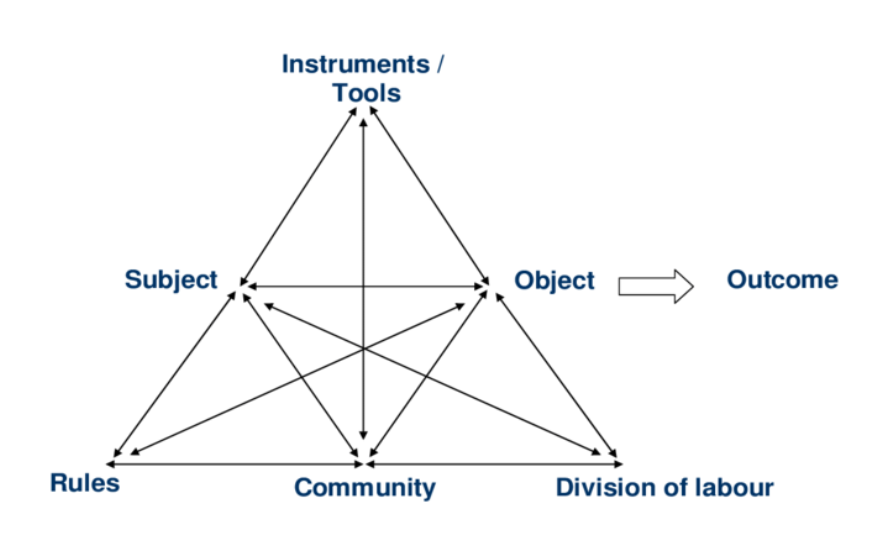
Figure 2 — Engeström's Activity System Triangle (1987)
The six-element activity system model. Each element mediates the relationship between subject and object. Contradictions arise within and between elements, old systems and new systems, and neighboring activity systems.
What the Lines Mean: The Web of Mediation
The lines in the triangle are not just borders; they are paths of influence. They show that no two elements in a system interact directly — there is always something "in the middle" shaping that interaction.
While every node can influence every other node, we usually start by looking at these primary paths of mediation:
Tools mediate Subject ↔ Object: We don't just "think" an object into existence; we use physical or symbolic tools (language, software, hammers) to work on it.
Rules mediate Subject ↔ Community: Your relationship with the people around you is governed by "how things are done here" — schedules, laws, or unwritten social norms.
Division of Labour mediates Community ↔ Object: How the community works on the object is determined by who does what, who has the power, and how tasks are shared.
The "Everything Affects Everything" Rule
In a living system, a change in one node sends ripples through all the others. For example:
A new Tool (like AI) might conflict with existing Rules (assessment policies).
A shift in the Division of Labour (a new manager) might change the Community dynamics.
The Object itself might evolve, forcing the Subject to find new Tools.
Contradictions & Outcomes
Each node and line is a potential source of contradiction. These tensions — for example, when a tool doesn't fit the rules — are where learning and systemic change occur. The Outcome represents the long-term transformation that results from the activity.
The Core Elements of an Activity System
An activity system is usually described through six connected elements.
You do not need to memorise them immediately. It is often more helpful to understand them gradually, in relation to your own research.
Subject
The subject refers to the person or group whose perspective you are focusing on. This is not "the individual in isolation," but the individual as part of the activity.
a teacher
a student
a team
Object
The object is the purpose or problem space that the activity is directed toward. It is sometimes helpful to think of the object as what the activity is trying to achieve or what is being worked on and transformed. The object gives direction to the activity.
improving digital literacy
completing a lesson
supporting student participation
Tools (Mediation)
Tools are the resources used in the activity. In CHAT, tools are not neutral. They shape how the activity takes place. For example, a digital platform may influence the pace of a lesson, how students interact, and what kinds of actions are possible.
Physical tools: e.g. devices, textbooks
Digital tools: e.g. platforms, software
Symbolic tools: e.g. language, instructions
Rules
Rules refer to the formal and informal guidelines that shape behaviour. Rules are often taken for granted, but they can have a strong influence on how activity unfolds.
schedules and time limits
institutional policies
classroom expectations
Community
The community includes all those who are involved in or affected by the activity. Looking at the community helps you see that activity is rarely individual. It is usually shared.
students
teachers
administrators
support staff
Division of Labour
The division of labour refers to how roles and responsibilities are organised. This element can help explain how work is distributed — and where tensions may arise.
who teaches
who supports
who participates
who makes decisions
Template — First Activity System Mapping
When you begin mapping your own system, you may find it useful to start with a simple outline:
Subject: ___________________________
Object: ___________________________
Tools: ___________________________
Rules: ___________________________
Community: ___________________________
Division of Labour: ___________________________
At this stage, your answers do not need to be complete. They can change as your understanding develops.
NorthCare — A System Takes Shape
Amara has her situation. Now she needs a way to represent it. Her instinct is to describe the problem in terms of people: the ward manager who pushed the EPR rollout, the nurses who resent it,
the IT team that provides insufficient support. But this is a cast of characters, not a system. CHAT asks her to think differently — not who is involved, but how the elements of the activity are structured and how they relate to each other.
Her first map is rough. She writes “nursing team” as the subject and “safe patient care” as the object. She lists the EPR and the handover sheet as tools, shift patterns and documentation standards as rules, doctors and ward managers as community. It feels incomplete — because it is. But it is a beginning. She will return to this diagram six more times before her thesis is submitted.
Figure 2 — Engeström’s Activity System Triangle (1987) — NorthCare
Amara’s first activity system map for NorthCare NHS Trust. Bidirectional arrows show that every node mediates every other — a change in any one element sends ripples through the whole system.
The activity system provides a relational model for making sense of practice. A first system map is an interpretive starting point, not a final diagram. The model used to represent this system is shown below.L’78Leontiev, A.N. (1978)Activity, Consciousness, and Personality. Prentice-Hall.
Core elements
Subject — the person or group whose perspective you are focusing on
Object* — the shared purpose or problem-space motivating the activity
Tools — mediating artefacts: physical, digital, and symbolic
Rules — formal and informal norms shaping action
Community — all involved in or affected by the activity
Division of Labour — how tasks, roles, and responsibilities are distributed
⚑ Critical Reflection — The Map Is Not the Analysis
Placing data into six nodes is not CHAT analysis. It is the preparation for analysis. Many researchers produce a well-labelled activity system diagram and then write a findings chapter that describes what sits in each node. This is a sophisticated version of description — but it is still description.
The analysis begins when you identify what happens between nodes: the contradictions, the frictions, the moments when what one element requires is incompatible with what another element produces. A system map with no identified contradictions is a map without an argument. Your examiners will see the difference immediately.
A useful self-check: can you state, in one sentence, what your system produces that it should not, or fails to produce that it should? If you cannot, the map is not yet finished.
⚑ Critical Reflection — When the Nodes Overlap
In real data, the boundaries between Rules, Community, and Division of Labour are frequently blurry. This is not a failure of your analysis — it reflects the genuine complexity of activity systems. But you still need to make a placement decision.
A practical decision sequence: Is this a codified expectation that applies to everyone in the system? If yes, it is probably a Rule. Is this a group of people whose shared perspective or interest shapes the activity? If yes, it is probably Community. Is this an allocation of specific tasks to specific roles? If yes, it is Division of Labour.
Where the same phenomenon fits more than one node, place it where its analytical weight is heaviest — where it creates the most significant tension with another element. The friction between your placement decision and an alternative placement is often where a secondary contradiction lives. Note it. It may be your most important finding.
The elements above can be brought together in a first working map. Use the template below to structure your initial representation.
Template — First Activity System Mapping
Subject: ______ Object: ______
Tools: ______ Rules: ______
Community: ______ Division of Labour: ______
Moving beyond a single diagram
Revisit your activity system at different points: an early version based on initial understanding, a revised version after data collection, a further version showing emerging tensions. The most important insights come not from identifying each element in isolation, but from how the elements interact — how tools relate to rules, how division of labour* affects the object, how community shapes what is possible.
Do This Now
Draw your first activity system triangle. Label all six nodes with what you know so far. Leave blank what you do not yet know. Put the date on it. This is Version 1. File it. You will return to it repeatedly, and the distance between Version 1 and your final version is evidence of your analytical development.
You cannot move to identifying contradictions until you have a working system map. It does not need to be correct — it needs to exist. Draw it now, even incompletely. The act of placing elements forces decisions about what belongs in the system and what belongs in the wider context. Those decisions are the beginning of your analysis.
The activity system is a working hypothesis, not a finished product — its value lies in what it reveals as you interrogate it against your data.
NorthCare — When the Map Stops Working
Three weeks into her fieldwork, Amara has four pages of notes, six informal conversations, and a system map that covers an A3 sheet and still feels incomplete. She has drawn and redrawn the nodes. She has moved the EPR system between Tools and Rules twice. She has added ward managers to Community, then removed them, then added them back with a question mark.
Her supervisor reads the map and asks one question: "What is the Object?"
Amara says: "Safe patient care."
Her supervisor says: "Is that what the nurses are working towards, or what the hospital says they should be working towards? Because your data suggests those might not be the same thing."
Amara goes home and redraws the map from the Object outward. It takes three hours. The new version has fewer nodes and raises more questions. It is better.
You cannot map an activity system until you have a situation that resists individual explanation. If your research problem can be fully answered by asking one person why they did something, you do not yet need CHAT. Return to the situation and look for the gap between what should be happening and what actually is.
3.Reading CHAT Literature and Writing Your Review
Use this chapter when you are beginning your literature review, writing your theoretical framework section, feel lost in the CHAT vocabulary, or are ready to move from reading to writing your positioning argument.
Read CHAT scholarship as system-building examples, not as fixed definitions. Every text is making choices about the system — your job is to understand those choices and make your own.
NorthCare — Reading to Build, Not to Master
Amara reads Engeström (1987) before her first fieldwork visit. She does not read to achieve mastery. She reads with a specific question in mind: what does Engeström mean by the object? She is already uncertain whether the object of nursing activity at NorthCare is safe patient care, or accurate documentation, or both — and whether that uncertainty is itself analytically significant. It is. The literature gives her a language for something she has already half-seen in her data. That is the right relationship between reading and analysis: the literature clarifies what the data is already suggesting, rather than imposing a framework onto data that has not yet been gathered.
CHAT literature can feel dense because authors vary in emphasis and vocabulary. The key is to read for structure, not definition. Different scholars — Engeström, Vygotsky, Leontiev, Bligh, Virkkunen — emphasise different parts of the system. Understanding these emphases helps you position your own theoretical choices. B’17Bligh, B. & Flood, M. (2017)“Activity Theory in Empirical Higher Education Research.” Tertiary Education and Management, 23(2).
The reading problem in CHAT studies
Most graduate students approach the CHAT literature with one of two problems. The first is reading too broadly too early — trying to master the full theoretical landscape before beginning fieldwork, and finding that the landscape is vast, contested, and internally diverse enough to be disorienting. The second is reading too narrowly too late — citing only Engeström (1987) and using the framework as a labelling device rather than an analytical one. Both produce weak literature reviews: the first produces a survey that lacks a focused argument; the second produces a thin theoretical justification that examiners will probe.
The solution to both is purposeful reading — reading in response to specific analytical questions generated by your data and your emerging system map, rather than reading to achieve comprehensive coverage or satisfy a citation quota.
What to look for when reading
Every CHAT text is making decisions about the system: what to include, what to name, how to connect the elements, and how to explain change. Reading analytically means noticing those decisions rather than absorbing the conclusions. The following three questions work across any CHAT text:
What is the unit of analysis? Does the author treat the individual, the interaction, or the activity system as the primary focus? If they claim to use CHAT but analyse individual
perceptions, there is a tension worth noting — and potentially worth naming in your review as a limitation of that study.
How are relationships between elements constructed? Does the author explain how tools shape rules, or how division of labour affects the object? Or does the text list elements without connecting them? The strength of a CHAT analysis lies in its relational claims, not in correctly labelling its nodes. A text that identifies six elements but does not explain how they interact is doing CHAT description, not CHAT analysis.
How is change or development explained? Does the author trace contradictions to their historical origins? If the system appears as a static snapshot — a description of how things are, without an account of how they got that way — the analysis is incomplete in CHAT terms, and your own study can distinguish itself by doing the historical work the cited study did not.
A worked reading example
The following passage is from Engeström’s 2001 paper “Expansive Learning at Work” — one of the most widely cited CHAT texts and a standard reference in most CHAT theses. Reading it analytically, rather than receptively, looks like this.
The Passage (Engeström, 2001, p. 137)
“The object of activity is a moving target, not a fixed endpoint. In the course of expansive learning, the object itself is reconstructed — it is both the starting point and the outcome of the transformation.”
A receptive reading notes: the object can change. That is true and worth knowing.
An analytical reading asks all three questions:
Unit of analysis: Engeström is not describing an individual’s goal. He is describing a collective, historically moving purpose — something the system is oriented toward, not the same as what any individual intends. When you map the object, you are not asking what participants are trying to achieve personally. You are identifying what the system as a whole is pointed toward — and noting where different participants’ understandings diverge. That divergence is data.
Relational claim: The object and the outcome are not the same thing. The object is the ongoing motive; the outcome is what is produced at a specific moment. In Amara’s study, the outcome of the EPR system (a completed, timestamped record) is not the same as the object of nursing (safe, responsive patient care). The system produces one while participants are oriented toward the other. That is a structural feature of the system — a secondary contradiction between tool and object.
Connection to your own system: In NorthCare, the object is contested — nurses and managers hold different versions, and the EPR embeds a third. Engeström’s claim gives Amara a theoretical warrant for treating that contest as analytically significant. She is not looking for the “correct” object; she is analysing what the multiplicity of object-versions reveals about the system’s contradictions. The literature has given her permission to treat the problem as structural.
Reading different scholars differently
Not all CHAT scholarship should be read the same way. The foundational texts — Vygotsky, Leontiev, Engeström (1987) — establish the conceptual architecture. Read them for the concepts, not for empirical findings. The empirical CHAT literature should be read for how the concepts are applied and adapted in settings like yours. Methodological texts — Virkkunen and Newnham, Bligh and Flood — should be read for research design decisions. These three types serve different purposes and belong in different parts of your thesis.
When reading empirical CHAT studies, add a fourth question: what does this study do that my study is building on, departing from, or doing differently? Your literature review should position your study in relation to existing work, not merely cite it. A study that found a secondary contradiction between tools and rules in a school setting is relevant to an NHS study, but the relevance needs to be articulated: similar contradiction type, different institutional context, different historical trajectory. That articulation is what makes a review an argument rather than an annotated bibliography.
Reading against the grain
Some of the most productive literature reading involves noticing what a CHAT text does not do — and using that absence to define your own contribution. A study that identifies contradictions but does not trace their historical origins gives you a gap to fill. A study that uses the Change Laboratory but compresses it into two sessions gives you a methodological contrast to articulate. A study that focuses on subject and object nodes but neglects division of labour gives you an analytical dimension to foreground. Reading for absence is not a dismissive critical exercise — it is a way of locating the space your study will occupy.
The lineage problem: Vygotsky, Leontiev, Engeström
Most CHAT theses spend several pages tracing the intellectual lineage from Vygotsky through Leontiev to Engeström. This is not wrong, but it is often longer than it needs to be and less analytically purposeful than it could be. A useful discipline: each step in the lineage should do analytical work, not just establish credentials.
Vygotsky matters because mediation is foundational to understanding why your tools matter analytically, not just descriptively. Leontiev matters because the distinction between activity, action, and operation explains why participants can describe their individual actions without ever naming the structural object those actions serve. Engeström matters because the six-node model and the concept of contradictions provide the analytical vocabulary your study depends on. Two or three paragraphs, each ending with a sentence that connects the concept to your own study, is more effective than two pages of intellectual history. If a paragraph about Vygotsky could be removed without affecting your analytical argument, it belongs in a footnote.
Building your reading list strategically
Build your reading list in three tiers. The first tier is non-negotiable: Engeström (1987), Vygotsky (1978), Leontiev (1978), and Engeström (2001). These four texts are the foundation. If you have not read them, your theoretical framework is not yet established.
The second tier is field-specific: two or three empirical CHAT studies in a setting similar to yours, and one or two methodological texts relevant to your design. These allow you to position your study within existing scholarship and demonstrate that you know the field.
The third tier is responsive: texts you read because your data raises a specific question the first two tiers do not answer. This tier grows throughout the study and cannot be fully planned in advance. If you find yourself identifying something that looks like a quaternary contradiction, you go back and read Engeström on boundary crossing. If your participants’ accounts raise questions about professional identity, you read Edwards on relational agency. Let the data tell you what else you need.
NorthCare — When the Data Sends You Back to the Literature
Halfway through her analysis, Amara finds something she did not expect. The ward manager describes the EPR implementation in almost entirely positive terms, using language about “accountability” and “transparency” that the nursing staff never use. Amara initially codes this as multi-voicedness. But something feels more structural — the manager seems to be operating with a different understanding of what the ward’s activity is fundamentally for. Amara goes back to the literature and finds Engeström’s work on quaternary contradictions between neighbouring activity systems. The ward nursing system and the hospital management system are not simply two perspectives on the same activity. They are two different activity systems with different objects, different tools, and different divisions of labour
— and the EPR sits at the intersection between them, serving both objects imperfectly. The literature did not tell Amara this. The data did. The literature gave her the words for it.
Do This Now
Build your three-tier reading list. Write the first tier from memory — if you cannot name the four foundational texts without looking them up, start there. Then identify two empirical CHAT studies in a setting similar to yours and one methodological text relevant to your design. That is your minimum reading before fieldwork. As you collect data, keep a running list of questions your data is raising that your current reading does not answer. Those questions are your third tier — and they are the sign of a study that is analytically alive.
Do This Now — Analytical Reading Practice
Take one page from any CHAT text you are currently reading and apply the three analytical questions: What is the unit of analysis? What relational claim is being made? Where does this connect to your own system? Add a fourth: what does this study not do, and how does that absence define a space for your own contribution? Write your answers in your research journal before reading further. The discipline of answering all four questions for every section you read is what turns a literature review from a summary into an argument.
From reading to writing: your CHAT literature review
Reading CHAT literature and writing your CHAT literature review are connected but distinct tasks. The reading guidance above is about orientation — knowing what to look for, how to read analytically, and how to build a purposeful list. What follows addresses the writing task: how to translate that reading into a literature review that does the analytical work a CHAT thesis requires.
The literature review in a CHAT thesis has a specific job that is different from literature reviews in other qualitative traditions. It is not primarily a survey of what others have found. It is an argument for why the activity system model — and the specific concepts you are drawing on — is the right analytical apparatus for your research problem. Every section of your literature review should be traceable to a decision you have made about your own study.
Structure: two layers, not one chapter
Most CHAT theses need two distinct layers of literature work, which may appear in the same chapter or in separate chapters depending on your institution’s conventions. The first layer is the theoretical framework: CHAT itself, its conceptual vocabulary, and how you are positioning your use of it. The second layer is the substantive context: the literature about the setting, the phenomenon, or the policy you are studying. Both layers are necessary. A CHAT thesis with a strong theoretical chapter but no engagement with the substantive literature leaves the reader unable to assess the significance of the findings. A thesis with rich substantive literature but thin theoretical framing leaves the reader uncertain whether the researcher actually understands the framework they are using.
What your CHAT literature review must establish
Your unit of analysis — why the activity system, rather than the individual, the dyad, or the institution, is the appropriate focus for your specific research problem.
Your key concepts and their provenance — which elements of the activity system model you are drawing on most heavily, and from which scholars. If you are using Engeström’s contradiction typology, cite it. If you are using Edwards’s relational agency, establish why. Do not use concepts without citing the source that gives them their analytical meaning.
Your positioning within CHAT scholarship — CHAT is not monolithic. Engeström, Bligh, and Virkkunen emphasise intervention and development. Edwards emphasises professional practice and relational agency. Daniels emphasises Vygotskian foundations. Your literature review should show where your study sits within these emphases and why - the tradition is internally diverse, and choosing your emphasis is itself a positioning decision.
Why CHAT rather than an alternative — this does not require an exhaustive comparison of every qualitative approach. It requires a focused argument for why your specific research problem requires the kind of systemic, historically grounded, relational explanation that CHAT provides — and why description of individual perceptions or thematic patterns would be insufficient. Chapter 6 provides a methodology justification template for your methods chapter; this argument, made at the level of the literature, belongs here.
Template — Positioning Your Study in the CHAT Literature
“This study draws on Cultural-Historical Activity Theory (Engeström, 1987; Leontiev, 1978; Vygotsky, 1978) as a framework for examining [phenomenon] as a system of collective, tool-mediated activity. Specifically, it employs the concept of [key concept] to analyse [specific analytical focus], following [scholar] in treating [theoretical position]. This approach is chosen over [alternative] because [specific reason grounded in the research problem]. The study contributes to a body of CHAT research in [substantive field], including [2–3 key empirical references], while extending that work by [specific contribution].”
Do This Now — Write Your Positioning Paragraph
Write your CHAT positioning paragraph using the template above. Fill in every blank. If you cannot complete the sentence “This approach is chosen over [alternative] because [reason grounded in the research problem],” return to Chapter 6 and work on your methodology justification before writing further — the two arguments are connected, and you will often need to write the methodology justification first. The positioning paragraph is the spine of your literature review. Everything else hangs from it.
You cannot justify your use of CHAT without having read the four foundational texts. But you do not need to have read everything before you begin fieldwork. Read the first tier. Then let your data tell you what else you need to read.
📄 Supervisor’s Corner — Primary Sources and the Literature Review
This handbook gives you a working knowledge of CHAT sufficient to begin your literature review and system map. It is not a substitute for engagement with the primary texts. Your supervisor — and your examiners — will want to see that you have read Engeström (1987), Leontiev (1978), and Vygotsky (1978) directly, not only via secondary commentary.
The test is simple: when you cite a CHAT concept in your thesis, can you trace it to its source? “Contradictions drive expansive learning (Engeström, 1987, p. 78)” is a primary citation. “As the literature shows, CHAT emphasises contradictions” is not. Your examiners will look for page numbers, specific arguments, and evidence that you have engaged with the theoretical claims, not just the vocabulary.
Your supervisor may ask: “Can you explain what Engeström means by a secondary contradiction in your own words?” and “How does your use of that concept relate to Leontiev’s original account of activity?” These are not trick questions. They are invitations to demonstrate that you understand the intellectual tradition you are working in, not just the model you are applying. Use this handbook to navigate. Return to the primary texts to anchor.
The literature is most useful when read as a set of choices about how to construct and analyse a system — read to learn how others made those choices, identify where they fell short, and then make your own.
4.From Situation to Research Question: Identifying the Gap
Use this chapter when you have read your CHAT literature, have a working sense of your activity system, and need to move from “there is a problem here” to a defensible research question.
The research question does not come from your reading. It comes from the gap your reading reveals between what the literature explains and what your situation requires explaining.
NorthCare — The Question That Would Not Resolve
Amara has read extensively. She can trace the lineage from Vygotsky through Leontiev to Engeström. She has mapped her activity system in outline. She knows the EPR implementation is not working as intended. But when her supervisor asks “What is your research question?”, she produces a sentence that is really a problem description: “Why are nurses not using the EPR system effectively?”
Her supervisor points out three problems with it. First, it assumes the issue is with the nurses. Second, it has no CHAT specificity — any qualitative approach could ask it. Third, it does not tell the reader what kind of explanation the study is going to produce. Amara knows what she is looking at. She does not yet know what claim she is going to make about it.
That is a gap problem, not a reading problem. The literature has not told her what is wrong. It has told her what the existing accounts assume. The question is what her system reveals that those accounts cannot explain.
The two types of gap
Research questions in CHAT theses emerge from two connected gaps, which are often confused because they are usually found at the same moment — when you have read enough to know what the literature assumes, and observed enough to know that your situation does not fit those assumptions.
The practice gap is the tension in the activity system itself: the contradiction between what the system is designed to do and what it actually produces. You can see this gap in your data. Nurses defer documentation. The EPR generates end-of-shift clusters. Care and record-keeping make incompatible demands at the same moments. The practice gap is what you observe. It is not yet a research question.
The literature gap is the space between what existing scholarship explains and what your practice gap requires explaining. The literature on EPR implementation explains adoption failure through user factors: training, resistance, compliance. Your practice gap shows that even compliant, trained nurses defer documentation under predictable structural conditions. Existing accounts cannot explain that — because they do not look at the relationship between the Tool and the temporal Rules of the activity system. That is the literature gap.
The research question lives at the intersection of both gaps. It names what you observed (practice gap) and positions it against what the literature has not yet explained (literature gap). A research question that describes only the practice gap is a problem statement. A research question that describes only the literature gap is a literature review objective. The CHAT research question does both.
How the Gaps Connect
Practice gap: What your activity system produces that it should not, or fails to produce that it should. Visible in your data. Named in your contradiction analysis.
↓
Literature gap: What existing accounts assume or overlook that prevents them from explaining your practice gap. Named through your reading.
↓
Research question: The intersection. Names what you observed and what the existing literature cannot explain about it. Positions the study as necessary.
What CHAT research questions look like
CHAT research questions have a specific structure that distinguishes them from descriptive qualitative questions. They ask about how a system produces an outcome, not whether an outcome occurs or what people think about it. They name the unit of analysis (the activity system or a relationship between its elements), and they imply a relational, structural explanation rather than an individual or perceptual one.
Three structural features distinguish a strong CHAT research question from a weak one. It specifies the activity system or system element under analysis. It asks a question that a structural, systemic answer can resolve — not one that only individual testimony can address. And it implies the kind of explanation the study will produce: a claim about how system elements interact, mediate, or contradict, not a theme or a category.
Worked Examples — Weak vs Strong CHAT Research Questions
Weak: “Why are nurses not using the EPR system effectively?” Problem: Asks about individual behaviour. Assumes the problem is with the nurses. Any qualitative approach could answer it. Has no CHAT specificity.
Stronger: “What contradictions exist between the EPR system and nursing practice at NorthCare?” Problem: Better — names contradictions, implies system analysis. But it is still descriptive. It asks what contradictions exist, not how they produce a specific outcome or what that reveals about the system.
Strong: “How do secondary contradictions between the EPR system (Tool) and the temporal structure of shift-based nursing (Rules) produce documentation displacement in an acute care activity system?” Why it works: Names the system elements in tension. Specifies the type of contradiction. Names the outcome (documentation displacement). Implies a structural explanation. Positions CHAT as the necessary framework — only a system-level analysis can answer it.
Main questions and sub-questions
Most CHAT theses have one main research question and two or three sub-questions. The main question states the system-level claim you are investigating. The sub-questions break it into the analytical moves your data needs to make: mapping the system, identifying the contradictions, tracing their development, and examining their consequences. The sub-questions are how your chapters are organised. The main question is what your thesis answers.
A common mistake is writing sub-questions that correspond to chapters rather than to analytical moves. “What does the literature say about EPR implementation?” is not a sub-question; it is a chapter task. Sub-questions should all be answerable from your data. If a sub-question requires only reading, it is not a research sub-question — it is a literature review objective, and it belongs in your research rationale, not your question set.
NorthCare — Main Question and Sub-Questions
Main question: How do secondary contradictions between the EPR system and the temporal Rules of shift-based nursing produce documentation displacement in an acute care activity system, and what does this reveal about the limitations of behavioural accounts of EPR adoption?
Sub-question 1: How is the NorthCare activity system structured, and what are its dominant objects and mediating tools?
Sub-question 2: What contradictions exist between system elements, and how are they evidenced across data sources?
Sub-question 3: How have these contradictions developed historically, and what does their persistence reveal about the structural conditions of EPR implementation?
Each sub-question is answerable from data. None requires only reading. Each maps onto an analytical chapter without being a chapter task.
How research questions actually emerge
Research questions in CHAT studies rarely arrive fully formed at the proposal stage. The first version is almost always too broad, too descriptive, or too individual-focused. This is normal. What matters is understanding the mechanism by which they sharpen: a question sharpens when the literature gap becomes specific.
Amara’s question sharpened not from more reading but from one specific moment of reading: the point at which she found that behavioural accounts of EPR adoption did not predict end-of-shift clustering, because they looked at individuals rather than system structures. At that moment the literature gap became nameable. The question followed from it.
The practical implication is this: do not expect your final research question to be in your proposal. Expect it to be in your analysis chapters. Work backwards from it to your methodology justification. This is not a failure of planning; it is how analytical research works. The viva question “how did your research questions emerge?” has a correct answer for a CHAT study: they emerged from the intersection of your data and your reading, and you will show the examiner exactly where.
Template for drafting your research question
Template — CHAT Research Question
Main question: “How do [type of contradiction / system element relationship] between [system element A] and [system element B] produce [specific outcome] in [named activity system], and what does this reveal about [existing account / assumption in the literature] that [your study is positioned to challenge]?”
Sub-question 1 (system mapping): “How is the [named activity system] structured, and what are its dominant objects and mediating tools?”
Sub-question 2 (contradiction identification): “What contradictions exist between [elements], and how are they evidenced across data sources?”
Sub-question 3 (historical or consequential): “How have these contradictions developed [historically / across time], and what does their [persistence / escalation] reveal about [the structural conditions / implications for practice]?”
Fill in the brackets. If you cannot complete the main question template, one of two things is missing: either the literature gap is not yet specific (return to Ch 3), or the practice gap is not yet named as a contradiction (go to Ch 5 after your system map).
What goes wrong
The question describes rather than explains. “What are nurses’ experiences of EPR implementation?” is a phenomenological question. It asks for accounts and perceptions. A CHAT question asks how a system structure produces an outcome — an answer that requires structural evidence, not only testimony.
The question is answerable without CHAT. If thematic analysis could answer your research question, it is not yet a CHAT research question. The question should name a system element, a relationship between elements, or a structural mechanism that CHAT’s analytical vocabulary is specifically equipped to illuminate.
The question is unanswerable from data. “How should healthcare organisations implement EPR systems?” is a policy recommendation, not a research question. It cannot be answered by your data; it can only be implied by your findings. Move it to your implications section.
There are too many sub-questions. More than four sub-questions usually indicates that the main question has not done enough analytical work. Each sub-question is a data chapter. Four sub-questions is four empirical chapters, which is too many for most doctoral theses. Three is the target.
Do This Now — Draft Your Research Question
In two sentences, name your practice gap: what does your activity system produce that it should not, or fail to produce that it should? Then name your literature gap: what do existing accounts assume that prevents them from explaining what you have observed? Now write a draft main research question using the template above. If you cannot fill in every bracket, note which one you cannot fill and return to the relevant chapter. The bracket you cannot fill is the next problem to solve.
You do not need a finalised research question before beginning fieldwork. You need a working question that is specific enough to guide your data collection decisions. The final form of the question will emerge from your analysis. What you must have is the literature gap: if you cannot name what existing accounts cannot explain, you cannot justify your study.
Use this chapter when you are analysing the tools in your system and need to understand what each one makes possible, forecloses, and assumes about the activity.
Human activity is always mediated — never direct or unfiltered.
NorthCare — Two Tools, Two Theories of Work
Amara watches a nurse complete a medication round. In her right hand, the nurse carries a printed handover sheet annotated in four colours of pen. On the wall behind her, the bedside terminal waits, its cursor blinking. The nurse glances at the screen, then back at the paper, then moves on. She will enter the data later — “when it goes quiet,” she says, though it never quite does.
Amara notes this as a mediation problem before she has the language to name it. The EPR system and the handover sheet do not do the same thing. They mediate nursing practice in structurally different ways — and the nurse’s preference for the paper is not resistance. It is evidence that one tool fits the activity and the other does not.
Tools are not simply instruments people use. In CHAT, tools shape what is possible within the system itself. They carry historical traces of prior practice and constrain or enable action in specific ways. V’78Vygotsky, L.S. (1978)Mind in Society. Harvard University Press.
Figure 2 — Mediated Action: NorthCare Nursing Practice
At NorthCare, two mediating artefacts compete: the EPR system (designed for audit) and the handover sheet (designed for clinical communication). Neither is neutral — each embeds a different theory of what nursing work is for.
Tools include
Technology and digital platforms
Language and discourse
Institutional rules and policies
Cultural practices and conventions
Analysing mediation means asking: what does this tool make possible, and what does it foreclose? How does it carry the history of the system into present practice? A tool that appears neutral is rarely so — it embeds assumptions about how work should be done, by whom, and at what pace.
Do This Now
List every tool present in your activity system. For each one, answer three questions: Who designed it, and with what model of practice in mind? What does it make possible? What does it make difficult or impossible? If any tool is poorly understood, you need more data before you can analyse it. Incomplete tool analysis produces weak contradiction identification.
You cannot identify contradictions in your system until you have analysed what each tool makes possible and what it forecloses. For every tool in your system, ask: who designed this, with what model of practice in mind, and how does that model fit — or not fit — the activity as it actually occurs? That mismatch, if it exists, is your first candidate for a secondary contradiction.
Analysing mediation means asking not just what a tool does, but what assumptions about practice it carries — and whose assumptions those are.
6.Contradictions: Identifying System Tensions
Use this chapter when you have a working system map and data that shows tensions, breakdowns, or gaps between intended and actual practice.
Contradictions are not errors in your data — they are structural features of the system.
NorthCare — Tension Becomes Visible
Three weeks into fieldwork, Amara notices a pattern. Every time she observes a high-dependency period — a deteriorating patient, a rushed medication round, a complex admission — EPR documentation stops. Nurses revert entirely to paper. Then, when the immediate crisis passes, they face a backlog of records to enter, often from memory, often after their shift has officially ended.
This is not a behaviour problem. It is a structural problem. The EPR system requires something — continuous real-time documentation — that the activity cannot provide during its most demanding moments. The tool and the rules it operates within are in direct tension. Amara has found her first contradiction.
Contradictions* emerge as recurring breakdowns, mismatches between intention and practice, or misalignment between system elements.
They are the engine of development and change — the reason systems do not stay still. E’87Engeström, Y. (1987)Learning by Expanding. Ch. 2.
The contradictions Amara identified are illustrated below.
Figure 3 — Contradictions in the NorthCare Activity System
At NorthCare: a primary contradiction exists within the EPR system itself (designed for audit and for care simultaneously). A secondary contradiction exists between the EPR tool and shift-pattern rules. A tertiary contradiction exists between the ward’s established practice and the new digitised model. A quaternary contradiction exists between the ward system and the management reporting system.
Four types of contradiction
Primary — within a single element (e.g., a tool serving two conflicting purposes)
Secondary — between two elements (e.g., Tool requires time; Rules limit time)
Tertiary — between an existing system and a more advanced form of activity
Quaternary — between the central system and a neighbouring activity system
Contradictions are not always stated directly. Look for patterns in your data: repeated delays, differences between expectations and practice, participant frustration. Statements like “We are expected to use the platform, but there is not enough time” point toward underlying systemic tensions.
Think of your context. Identify one contradiction using the template below.
Template — Identifying a Contradiction
“A tension exists between ______ and ______, because ______.”
Example: “A tension exists between the EPR system’s requirement for real-time documentation and the pace of acute nursing care, because entering data at the bedside takes time that is not available during high-dependency periods.”
NorthCare — Three Contradictions, All Evidenced
Amara’s three contradictions take weeks to identify. Each requires triangulation across data sources before she will name it. The secondary Tool–Rules contradiction is supported by observation logs showing documentation gaps during high-dependency periods, interview data in which nurses describe timing pressures, and shift records showing EPR entries clustered at the end of shifts rather than throughout them. The secondary Tool–Object contradiction is supported by interviews in which nurses distinguish between “what the system needs” and “what the patient needs.” The tertiary contradiction is supported by historical accounts of how handover used to work and why it felt more reliable. Each contradiction is named only after the evidence makes it unavoidable.
Do This Now
Complete this sentence for each tension you have observed: “A tension exists between [element] and [element], because [structural explanation].” If you cannot complete the sentence
— if the “because” clause remains vague — the contradiction is not yet analytically grounded. Return to your data and look for more evidence before naming it.
⚑ Critical Reflection — A Problem Is Not a Contradiction
Not every difficulty in your data is a contradiction. A contradiction, in the CHAT sense, is a structural incompatibility between two elements of the activity system that is reproduced by the system’s own logic — not resolved by working harder or communicating better.
A useful diagnostic: Could this tension be resolved if the right people had a good meeting? If yes, it is probably an organisational problem, not a structural contradiction. A contradiction persists because the system structure that produces it remains unchanged. It is not caused by bad actors or poor management. It is caused by incompatible systemic demands.
A second diagnostic: Does this tension appear across independent data sources? A genuine contradiction leaves traces in interview data, observation data, and documentary data simultaneously — because it is structural, not situational. If you can only see it in one source, return to your data before naming it a contradiction.
NorthCare — When the Contradiction Doesn't Hold
Amara has identified what she is calling a primary contradiction. She writes it up, sends it to her supervisor, and waits.
The response arrives in two lines: "This reads like a complaint about management rather than a structural analysis. What is the systemic reason this tension cannot be resolved by goodwill alone?"
Amara reads this three times. She is not sure she knows the answer. She goes back to her interview transcripts and reads them again, this time looking not for what people say is wrong, but for what the system requires them to do simultaneously that cannot both be done. She finds it on page 34 of her third transcript, in a sentence she had highlighted and then ignored.
The contradiction she writes the following week is tighter, more evidenced, and structurally grounded. It is also less satisfying to read, because it no longer sounds like anyone is to blame. That, her supervisor tells her, means she has it right.
You cannot write your findings chapter until each contradiction is supported by evidence from at least two data sources. If you can only find one piece of evidence for a tension, return to your data. Either the contradiction is not yet fully visible, or it is an anomaly rather than a structural feature. Structural contradictions recur. They leave multiple traces.
📄 Supervisor’s Corner — What Your Supervisor Sees in a Methodology Chapter
CHAT is not a neutral analytical toolkit. It has philosophical roots in the Marxist tradition of dialectical materialism: the claim that contradictions are the engine of historical development, and that human activity is always historically situated, always mediated, and always oriented toward an object that is itself contested. A methodology chapter that treats CHAT as a mapping framework without acknowledging this philosophical substrate will concern an experienced examiner.
What your supervisor is looking for: evidence that you understand why CHAT explains what it explains, not just how it is applied. The methodology chapter must show that your choice of CHAT was driven by an epistemological commitment — a claim about the kind of explanation your research problem requires — not simply by familiarity with the model.
A useful sentence to draft: “CHAT is chosen for this study because the research problem requires a systemic, historically grounded account of [phenomenon] — an account that locates causality in the structural relationships between system elements rather than in individual psychology or organisational culture.” If you cannot write a sentence like this in your own words, return to Chapter 3 before finishing your methodology chapter.
From Contradiction to Thesis Claim
Identifying a contradiction is an analytical act. Translating it into a thesis-level claim is a different one. Examiners do not simply want to know that a tension exists — they want to know what it reveals, what it challenges, and why it matters. The gap between “a contradiction is present” and “this contradiction demonstrates” is where the PhD chapter lives.
Start with what the tension makes visible. If the contradiction between the EPR system and shift patterns reveals that the digitisation programme was designed without modelling the temporal structure of acute nursing work, that is a claim — one with scope, implications, and something for an examiner to push back on. Move then to what resolution would require. If fixing the problem demands a redesign of documentation logic rather than further nurse training, say so directly. That is not a recommendation; it is a finding. Then name what your case adds to the existing literature. If it extends or qualifies a concept from Engeström or Leontiev, the extension needs to be explicit. That is the theoretical contribution.
Template — Contradiction to Thesis Claim
Contradiction identified: “A tension exists between [element] and [element], because [structural explanation].”
What it reveals: “This primary/secondary/tertiary/quaternary contradiction (tension) makes visible ______ — a feature of the system that [prior accounts / management descriptions / individual-level explanations] could not account for.”
What it implies: “Resolving this tension would require ______, not ______. This has implications for [practice / policy / theory] because ______.”
Theoretical claim: “This case [extends / qualifies / illustrates] [concept] by showing that ______.”
Contradiction type
What it typically reveals
The kind of claim it supports
Primary (within one node)
Internal logic of a tool, rule, or role is self-contradictory
Systemic design flaw; not solvable by individual action
Secondary (between nodes)
Two elements of the system have incompatible demands on the subject
Structural impossibility; resolving one tension worsens another
Tertiary (old vs new object)
A prior, more coherent version of the activity is being displaced
Historical claim; the change introduced the problem, not the people
Quaternary (between systems)
Adjacent activity systems impose conflicting requirements
Boundary claim; the site of change is at the interface, not inside
This is the moment your analysis becomes an argument. The contradiction gives you the evidence. The claim gives the examiner a position to engage with. Without the claim, a CHAT thesis can feel like a very well-executed mapping exercise. With it, the mapping becomes the ground for an original theoretical contribution.
Examiners are looking for a thesis that uses CHAT to say something that could not have been said without it. Your contradiction is the instrument. Your claim is the finding. Both must be in your abstract, your findings chapter, and your viva answer to “what is your original contribution?”
The “So What?” Table
Use after naming a contradiction. Use before writing your findings chapter. Use again before your viva.
The typology tells you what kind of claim your contradiction supports. This table forces you to justify it. The difference matters: classification stays inside the method; justification enters the field. Complete one table per major contradiction before you write your findings chapter. If your answers to the three highlighted rows feel safe, they are not yet strong enough.
Step
NorthCare example
Your study
The contradiction
EPR demands real-time entry; acute care does not allow it
Why this is not an individual problem
No nurse is failing — the system design makes compliance impossible under real conditions
What this reveals about the system
The system is designed around administrative time, not clinical time
What this challenges in the field⚡
The assumption that digitisation improves efficiency in clinical settings
What your study adds (your claim)⚡
Healthcare IT design must align with activity rhythms, not just task logic
Why this matters beyond your case⚡
Similar failures are likely wherever high-tempo care meets audit-driven systems
Examiner question this answers
“What is your original contribution?”
⚡ These three rows are where students stop describing and start entering academic conversation. If your answers feel safe or obvious, push harder. A claim that cannot be challenged is not yet a claim — it is a summary.
Using both tools together
The typology names the kind of claim your contradiction supports. The So What? table forces you to make it. Use the typology first, then sit with the table. Most students who struggle with their findings chapter have done the analysis. They have not done the arguing.
Do This Now
Complete the table for your strongest contradiction. If you cannot fill in “What this challenges in the field” with a named assumption from the literature, return to your literature review. That row is where your empirical work enters the academic conversation. Without it, the contribution does not exist yet.
If completed properly, this table should now be writable as a short analytical paragraph. If it is not, the argument is not yet clear enough.
From Table to Paragraph
The secondary contradiction between the EPR system and shift patterns demonstrates that real-time documentation is structurally incompatible with the temporal demands of acute care. This is not the result of individual non-compliance but of a system designed around administrative time rather than clinical activity. This challenges the assumption that digitisation inherently improves efficiency in healthcare settings. Instead, the findings suggest that effective system design must account for activity rhythms, not just task completion. This has implications beyond the case, as similar tensions are likely to emerge wherever high-tempo care intersects with audit-driven documentation systems.
This paragraph is not the end of the analysis. It is the smallest complete version of your findings — the rest of the chapter builds from it.
Engeström, Y. (1987). Learning by Expanding. Orienta-Konsultit.
Engeström, Y. (2001). Expansive Learning at Work. Journal of Education and Work, 14(1).
7.Methodology, Design, and CHAT vs Other Approaches
Use this chapter when you are writing your methodology chapter, preparing to justify your approach to a supervisor, or anticipating the viva question "why not thematic analysis?"
CHAT is a theoretical framework, not a fixed method. Know why you have chosen it.
NorthCare — Why CHAT and Not Something Else
Amara’s supervisor asks her a direct question in their second meeting: “Why not thematic analysis? You have interviews. You could code them for themes.” Amara knows the answer but has to find the words for it. Thematic analysis would tell her what nurses say about the EPR system. It would not tell her why those things are being said — what structural features of the activity produce the experience nurses are describing. The gap she is trying to explain is not a gap in nurses’ perceptions. It is a gap in the system. That is why she needs CHAT.
CHAT provides a conceptual lens, informs how research is designed and interpreted, and supports explanation of complex systems. It does not replace your methodology — it informs and guides it. Always distinguish: CHAT provides the lens; your methods provide tools for collecting data; your methodology explains how and why these fit together. B’17Bligh, B. & Flood, M. (2017)“Activity Theory in Empirical Higher Education Research.” Tertiary Education and Management, 23(2).
CHAT vs other qualitative approaches
The most common challenge in a CHAT methodology chapter is justifying the framework choice against alternatives a supervisor or examiner might reasonably propose. The table below positions CHAT against three adjacent qualitative approaches — not to argue for its superiority in the abstract, but to sharpen the case for why your specific research problem requires a systemic and historically grounded explanation. For guidance on writing the CHAT literature review — including structure, what to establish, and a positioning template — see Chapter 3.
Approach
Focus
Output
Thematic Analysis
Recurring themes in participant accounts
Descriptive categories
Grounded Theory
Theory building from data
Conceptual model
Discourse Analysis
Language in context
Textual/rhetorical patterns
CHAT
System relations and tensions over time
Explanatory activity system
Template — Justifying the Use of CHAT
“This study adopts a CHAT framework to explore how ______ is shaped by the interaction of tools, rules, and community within the activity system. Data was collected using ______.”
Do This Now
Write your methodology justification in one paragraph. Include: what CHAT provides that other approaches do not; what your specific research problem requires that makes CHAT the appropriate choice; and what data collection methods you are using and why each one illuminates a different aspect of the activity system. Show it to your supervisor before proceeding to data collection.
You cannot write your methodology chapter until you can answer this question in one sentence: “I am using CHAT rather than [alternative] because my research problem requires explanation of [specific systemic feature] rather than description of [what the alternative would produce].” If you cannot complete that sentence, your justification is not yet strong enough.
Your justification for using CHAT should explain not just what the framework is, but why your specific research problem requires a systemic and relational explanation that other approaches cannot provide.
8.Research Instruments: Interview Protocol and Survey
Use this chapter when you are designing your data collection instruments, adapting them for your own context, or checking that your questions are genuinely aligned with your CHAT analytical framework.
If you are collecting data via weekly face to face or online sessions with your participants, go to the Extension Module: Intervention and Expansive Learning (Change Laboratory).
CHAT instruments are not generic data-gathering tools. Every question should serve the activity system — mapping an element, probing a tension, or tracing a historical layer.
NorthCare — Designing to See the System
Amara drafts her interview guide three times before she is satisfied with it. The first draft asks nurses how they feel about the EPR system. Her supervisor points out that this will produce attitudinal data — rich, personal, and analytically insufficient for CHAT. The second draft asks about the system’s impact on their work. Better — but “impact” is still a black box. The third draft asks about tools, rules, time, division of responsibility, and the purpose of nursing work. Each question is designed to illuminate a specific element of the activity system or a possible tension between elements. The guide is no longer a list of questions about the EPR. It is a systematic attempt to construct the activity system from participant knowledge.
Principles of CHAT-aligned instrument design
Before designing any instrument, identify which elements of the activity system each question is intended to illuminate. A question that does not serve the system map — that would produce data you could not place anywhere in your analytical framework — does not belong in your instrument. This is not restrictive; it is clarifying. It forces you to make your analytical intentions explicit before you enter the field.
The six system elements provide a natural organising structure. Most CHAT studies need data on: the tools participants use and how those tools shape their practice (mediation); the rules that formally and informally govern activity; the community involved and the different roles within it (division of labour); and the object — what participants understand the activity to be for, and whether that understanding is shared or contested. Historical data — what the activity looked like before any significant change — is a seventh category that many CHAT studies require.
Semi-structured interview protocol: NorthCare EPR study
The following protocol was used by Amara across her forty-two semi-structured interviews with nursing staff, ward managers, and IT support personnel at NorthCare. Each question is annotated with the system element it is designed to illuminate.
Interview Protocol — NorthCare EPR Implementation Study — Nursing Staff
Opening — Role and Context
1. Can you describe your current role on the ward and how long you have been working in this setting? [Subject; community; division of labour]
2. How would you describe what nursing work on this ward is fundamentally trying to achieve? [Object — participant’s understanding]
3. Has your understanding of what the work is for changed since the EPR system was introduced? [Object shift; historical comparison]
Tools and Mediation
4. Walk me through the tools and systems you use most frequently during a typical shift. I am interested in everything — digital and paper, formal and informal. [Tools; mediation]
5. Which of those tools do you trust most in a high-pressure situation, and why? [Tool hierarchy; mediation under constraint]
6. Are there any tools or systems you use that are not officially part of your documentation requirements? Can you tell me about those? [Workarounds; shadow tools; secondary contradiction indicator]
7. When you use the EPR system, what does it make easier? What does it make harder? [Mediation analysis; enabling/constraining]
Rules and Time
8. What are the documentation requirements that feel most non-negotiable in your daily work? Where do those requirements come from? [Rules; institutional norms; community expectations]
9. How much time do you spend on EPR documentation during a typical shift? How does that compare to before the system was introduced? [Rules; Tool–Rules tension; historical comparison]
10. Are there moments in a shift when EPR documentation is simply not possible? What do you do in those situations? [Secondary contradiction; workaround behaviour]
11. What happens to documentation that cannot be completed during a shift? [Rules; division of labour; object tension]
Community and Division of Labour
12. How is documentation responsibility shared across the team? Has that changed since the EPR was introduced? [Division of labour; historical comparison]
13. Are there colleagues who manage EPR documentation differently from you? What do you make of those differences? [Community; multi-voicedness*; division of labour variation]
14. Who benefits most from the EPR records you create? Who reads them, and for what purpose? [Community; object from different positions; quaternary contradiction indicator]
Historical Comparison
15. For those who remember it: how was patient documentation managed before the EPR? What did that system make possible that the current one does not? [Past activity system; historical layering; tertiary contradiction]
16. For those who have only worked with the EPR: what aspects of the current system feel most difficult to work with? Have longer-serving colleagues ever described a different way of doing things? [Present system from inside; absent historical comparison]
17. What has changed most significantly about how the ward operates since EPR implementation? What has stayed the same? [System development; historical layering]
Contradictions and Development
18. If you could change one thing about how documentation is structured on this ward, what would it be? [Object projection; modelling; expansive learning indicator]
19. Is there anything about the current system that feels fundamentally at odds with what you believe nursing is for? [Object tension; tertiary contradiction; transformative agency*]
20. Is there anything else you would like to tell me about how nursing documentation works on this ward — something I might not have thought to ask about? [Open close; multi-voicedness; unexpected system elements]
Interviews were conducted individually, lasting 45–75 minutes, and audio-recorded with consent. Follow-up probes were used throughout: “Can you give me an example of that?” / “What happened next?” / “Who else was involved?”
Adapting this protocol for your own study
Replace every reference to the EPR system, nursing, and NorthCare with the equivalents from your own research context. The structural logic of the protocol — opening on object, moving through tools and rules, tracing division of labour and community, seeking historical comparison, closing on contradiction and development — is transferable to any CHAT study. What is not transferable is the specific content. Your instrument must be grounded in your system, not borrowed from this one.
Do This Now
Draft your own interview protocol using this structure as a scaffold. For each question you write, note in brackets which system element it is designed to illuminate. If a question does not have a system
element annotation, either find one or cut the question. Every item in your instrument should serve the analysis.
Survey instrument: NorthCare EPR implementation study
Amara supplements her interviews and observations with a short survey distributed to all registered nursing staff across three wards at NorthCare (n = 74; response rate 68%). The survey is not designed to produce statistical findings. Its purpose is to map the distribution of the tensions identified in the interviews — to establish whether the contradictions Amara has observed are concentrated in particular roles or shifts, or are systemic across the workforce.
In CHAT research, surveys are most useful not as standalone instruments but as triangulation tools. They can confirm that a pattern observed in interview and ethnographic data is not an artefact of who you happened to speak to. They cannot, on their own, identify contradictions or explain their structural origins — that analytical work requires qualitative depth.
Survey Instrument — NorthCare EPR Implementation Study — Nursing Staff
Section A — Role and Context
A1. How long have you worked in nursing? [Subject; historical comparison eligibility]
☐
Under 2 years
☐
2–5 years
☐
6–10 years
☐
Over 10 years
A2. How long have you worked at NorthCare? [Pre/post EPR comparison eligibility]
☐
Under 18 months
☐
18 months – 3 years
☐
Over 3 years
A3. Which shift pattern do you typically work? [Division of labour; rules variation]
☐
Days only
☐
Nights only
☐
Rotating
☐
Other
Section B — Tools and Documentation (1 = Strongly Disagree, 5 = Strongly Agree)
B1. The EPR system fits naturally into the pace of my work on the ward. [Tool–Rules tension]
1
2
3
4
5
B2. I am able to complete EPR documentation at the time the activity occurs, during my shift. [Tool–Rules tension; real-time entry]
1
2
3
4
5
B3. I use documentation tools or records that are not part of the official EPR system. [Workaround tools; secondary contradiction indicator]
1
2
3
4
5
B4. The EPR system helps me provide better care to patients. [Tool–Object alignment]
1
2
3
4
5
Section C — Time and Rules (1 = Strongly Disagree, 5 = Strongly Agree)
C1. I have sufficient time during my shift to complete all required EPR documentation. [Tool–Rules secondary contradiction]
1
2
3
4
5
C2. I sometimes complete EPR records after my shift has officially ended. [Rules violation; object–rules tension]
1
2
3
4
5
C3. During high-dependency periods, EPR documentation becomes a lower priority than direct patient care. [Object–Tool tension; object hierarchy]
1
2
3
4
5
C4. The documentation requirements of the EPR system sometimes conflict with what I believe is most important in my role. [Object tension; tertiary contradiction indicator]
1
2
3
4
5
Section D — Historical Comparison
D1. If you worked at NorthCare before the EPR was introduced: overall, how has documentation practice changed? [Historical comparison; system development]
☐
Significantly better
☐
Somewhat better
☐
About the same
☐
Somewhat worse
☐
Significantly worse
☐
Not applicable
D2. What aspect of documentation practice has changed most significantly since EPR implementation? (Open response, 2–3 sentences)
[Historical layering; system development data]
Section E — Open Questions
E1. In one or two sentences, describe what you believe the EPR system is primarily designed to achieve. [Object from participant perspective; multi-voicedness]
E2. Is there anything else about how documentation works on your ward that you would like the research team to understand? [Open; unexpected system elements]
Survey distributed via ward managers; completed anonymously on paper and returned in sealed envelopes. Analysis focused on distribution of responses across shift type and experience band rather than aggregate means, in order to identify whether tensions were concentrated in particular system positions.
When to use a survey — and when not to
A survey is not a required component of a CHAT study. Many strong CHAT theses use no survey at all. Before deciding to include one, ask a specific question: what would a survey tell me that my interviews and observations cannot? If the answer is “the distribution of a pattern I have already identified qualitatively,” a survey may add value. If the answer is “I am not sure,” it probably will not.
Surveys are most useful in CHAT research when your setting involves a large number of participants across whom you cannot conduct interviews — and when you want to test whether a contradiction you have identified in interview and observation data is concentrated in a particular
system position (a specific role, shift pattern, or site) or is distributed across the system more broadly. They are least useful when your study is already analytically rich from interviews and observation, when your participant group is small enough that everyone can be interviewed, or when the questions you need to ask are too contextual and relational to translate into a survey format.
It is also worth being honest about what surveys cannot do in a CHAT study. They cannot identify contradictions — they can only confirm the distribution of patterns that qualitative analysis has already surfaced. They cannot explain why a tension exists — only how widely it is felt. And they can produce a false impression of quantitative rigour in a study that is fundamentally interpretive. If you include a survey, be explicit in your methodology chapter about its role: it is a triangulation instrument, not an independent source of findings.
Decision Guide — Should Your Study Include a Survey?
Include a survey if: your participant pool is large and not all can be interviewed; you want to test the distribution of a contradiction across roles or sites; you need to demonstrate that a qualitatively identified pattern is not specific to one or two participants.
Do not include a survey if: your participant group is small enough for full interview coverage; your research questions are relational and contextual rather than distributional; you do not have a specific analytical question a survey can answer; or adding a survey would dilute your interview and observation depth by consuming time and attention better spent on qualitative analysis.
In either case: design the survey after your early interviews, not before. The questions should be grounded in what your qualitative data has already begun to reveal, not generated in advance from the literature.
Using survey data in a CHAT analysis
The value of Amara’s survey lies not in its means but in its distributions. When she breaks down responses to C2 (“I sometimes complete EPR records after my shift has officially ended”) by shift pattern, she finds that the pattern is significantly more pronounced among rotating and night-shift nurses than among day-shift staff. This is analytically significant: it suggests the Tool–Rules contradiction is not uniformly distributed across the system, but is particularly acute at specific positions within the division of labour. That finding generates new interview questions, deepens the contradiction analysis, and ultimately strengthens the argument that the tensions are structural rather than individual.
Survey data in a CHAT study should always be interpreted through the analytical framework rather than presented as findings in their own right. The question is not “what percentage of nurses agree?” but “what does the distribution of agreement tell us about how this contradiction is structured within the activity system?”
Do This Now
Before deciding whether to include a survey, answer the decision guide questions above. If you conclude a survey is appropriate, draft five to eight questions using this instrument as a model. Annotate each question with the system element it illuminates. Design the survey after your first round of interviews, not before — the questions should be grounded in what your qualitative data has already begun to reveal.
Every question in a CHAT instrument should be traceable to a system element, a potential contradiction, or a historical comparison — if it is not, it does not belong in the instrument.
9.Ethics, Reflexivity, and Research Positioning
Use this chapter when you are writing your reflexivity section, navigating institutional politics, or managing participant disagreement with your findings.
The researcher is a tool within the system—their presence unearths contradictions that carry real-world consequences.
Ethics in CHAT research is not a box to tick before fieldwork begins. It is a continuous analytical and relational responsibility that runs through every stage of the study — from the way you frame your research questions, to the mirror data you select, to the interpretations you publish. Because CHAT seeks to unearth structural contradictions, your findings may inadvertently point toward systemic failures, management gaps, or professional tensions. That representation carries consequences.
NorthCare — The Ethical Friction of System Mapping
Amara presents her first system map to the ward managers. She has identified a "Secondary Contradiction" between the **Rules** (mandatory EPR entry) and the **Division of Labour** (nurses' actual time with patients). One manager is defensive, seeing the map as an accusation of poor oversight. Meanwhile, a nurse pulls Amara aside: "If you put that in your report, will they finally hire more staff, or just give us a 'time-management' seminar?" Amara realizes her map is not just a diagram; it is a political intervention that stakeholders want to weaponize or suppress.
The Dual Role: Analyst and Facilitator
In CHAT, you are rarely a "fly on the wall." You are often a facilitator—bringing participants together to look at "mirror data" (evidence of their own work). This dual position is not a problem to resolve — it is a condition to work with transparently.
Institutional Diplomacy: Framing findings as structural contradictions (gaps in the system) rather than individual failings (staff or management incompetence).
Managing Disagreement: Treat a participant’s rejection of your system map as **primary data**. A disagreement reveals a gap between perceived reality and systemic pressure.
Positional Reflexivity: Acknowledging how your own history (e.g., as a former clinician or an academic outsider) influences which tensions you "notice" and which you overlook.
Power Dynamics: Recognizing that the Change Laboratory is a social space where hierarchy still exists, even if you try to "flatten" it.
Do This Now: The Reflexivity Audit
Answer these three questions in your journal to draft your methodology's ethics section:
Framing: How am I ensuring my findings describe systemic tensions rather than personal blame?
Access: Whose interests am I serving by identifying these specific contradictions?
Contestation: What would I do if a key participant demanded I remove a specific contradiction from my final map?
You cannot complete your methodology chapter without a reflexivity section that accounts for your position within the system. This is an analytical requirement. Your system model is a construction; your contradictions are interpretations. Name the history and assumptions that led you to them.
📄 Supervisor’s Corner — "But is it Objective?"
A supervisor might ask how a "facilitated" study can be objective if you are influencing the participants. The CHAT response: Objectivity in CHAT isn't about being "neutral"; it’s about **analytical rigorousness**. We don't claim to be outside the system; we claim to make the system's hidden tensions visible so they can be studied. Your role as a "provocateur" is what allows the data to emerge in the first place.
Reflexivity in CHAT means making your interpretive choices visible. The system map is always a product of the researcher's lens; ethical research involves explaining why that lens was used.
Part III — Analysing Your Data
10.From Raw Data to Activity System: The Analytical Steps
Use this chapter when you have collected data and need to move from raw interview transcripts, observation notes, and documents toward a mapped activity system and named contradictions.
⚑ Critical Reflection — The Gap Between Data and System
The most common analytical failure in CHAT theses is the jump from raw data to system labels without showing the analytical steps in between. A finding that says “interview data shows Tool–Rules tension” without showing how the interview data was coded, what patterns were identified, and why those patterns constitute a structural incompatibility is not yet an analysis.
Before you code your full dataset, do this: take a single interview transcript and code one passage analytically. Ask for each sentence: which system element is being described or implicated? What relationship between elements does this reveal? What would have to be different in the system for this not to occur? This is slow work. It is supposed to be slow. The slowness is where the analysis happens.
Your supervisor will ask how you got from transcripts to the activity system diagram. “I read the transcripts carefully” is not an answer. “I coded each data source using the six system elements as analytical categories, then identified patterns of tension between elements across three independent sources” is an answer. The difference is methodological transparency, and it belongs in your methodology chapter.
The gap between collecting data and claiming contradictions is where most CHAT students stall. This chapter shows the analytical steps that bridge it.
Chapter 9 explains how qualitative data (interviews, surveys, and observations) are systematically coded and reconstructed into an activity system model using CHAT concepts. This is a researcher-led analytical procedure for constructing explanatory models of activity systems. It does not involve participant modelling, triangulation workshops, or Change Laboratory intervention.
NorthCare — Twelve Interviews and a Blank Triangle
After her first twelve interviews, Amara sits with forty-seven pages of transcript and a blank activity system triangle. She knows the framework. She has read the literature. She cannot see how to get from what nurses said to what the system looks like. This chapter is for that moment.
Data analysis in a CHAT study is not a single event. It is an iterative movement between data and framework, in which each pass deepens both your understanding of the data and your construction of the system. There is no shortcut through this process, but there is a sequence that makes it manageable.
Step 1 — Read before you code
Before applying any analytical framework to your data, read all of it once without coding. This sounds obvious and is frequently skipped. Reading without coding allows you to form an overall sense of the territory — what participants are concerned about, what keeps recurring, where the unexpected moments are. The patterns you notice in this first reading will orient your later analytical decisions in ways that are difficult to reproduce if you begin coding immediately.
Keep a running memo as you read. Note recurring words, repeated frustrations, moments where a participant says something that surprises you, and moments where different participants seem to be describing the same situation from different positions. These memos are data — file them with your transcripts, not in a separate document that will be lost.
Step 2 — Map data onto system elements
Return to your transcripts and, for each passage, ask: which element of the activity system is this participant describing? Not every passage maps to an element — some is contextual, some is narrative, some is biographical. But a significant proportion of interview data in a CHAT study will be describing, directly or indirectly, one of the six nodes. Mark those passages and note the element.
Use a simple coding system: T for tool, R for rules, C for community, DL for division of labour, S for subject, O for object. Do not force codes — if a passage does not clearly describe a system element, mark it as context or leave it uncoded for now.
If you find yourself assigning multiple elements to most passages, you are overcoding. Most data points should primarily describe one element, even if they gesture toward others.
The codes that matter most at this stage are those where the same element is being described differently by different participants. Those divergences are where contradictions begin to appear.
NorthCare Example — Mapping a Passage to Elements
Transcript extract, Nurse 4: “The thing is, during a crash you just can’t stop and type. You might not get back to the terminal for forty minutes. And then what you enter is basically from memory, which isn’t the same as entering it at the time.”
This passage maps to: T (EPR terminal — unavailable during crisis), R (requirement for real-time entry — structurally violated), and gestures toward O (the difference between an accurate record and what the nurse can actually produce). It is also the first indication of a secondary contradiction between Tool and Rules. Amara marks it T / R / contradiction-candidate and returns to it in Step 3.
Step 3 — Build the system map from coded data
Once you have coded a substantial portion of your data — not all of it, but enough to have covered each system element multiple times — begin to build your system map.
Your system map at this stage should look like six lists — one under each element — built directly from your coded data.
This map is not a diagram yet. It is a working document: a list under each heading of what your data says about that element.
This step often reveals gaps. You may have rich data on tools and rules but thin data on division of labour or community. Those gaps are a signal to return to the field — to ask a question you have not yet asked, or to seek out a participant whose position in the system you have not yet accessed.
It also often reveals convergences that complicate your initial coding. A passage you coded as describing a tool may, on reflection, be describing a rule — because the tool has become so embedded in practice that participants experience it as a mandate rather than an instrument. Note these ambiguities. They are analytically significant.
Step 4 — Identify contradiction candidates
A contradiction candidate is a pattern in your data where two system elements appear to be pulling in different directions. At this stage, it is a hypothesis, not a finding. You are asking: does this data suggest a structural tension between these elements? You are not yet claiming it as a contradiction.
The following signals are reliable indicators of contradiction candidates in interview and observation data:
Recurring workarounds — if multiple participants describe the same informal solution to the same problem, there is probably a structural tension that the workaround is compensating for
Complaints that participants cannot explain — “it just doesn’t work” or “it’s always been a problem” are invitations to dig for the structural cause
Divergent accounts of the same situation — when a manager and a frontline worker describe the same system very differently, the divergence often reflects different positions within the division of labour and different relationships to the object
Moments of visible frustration or resignation in observation data — a participant who abandons a system or switches tools is showing you something that interview data alone would not reveal
Breakdowns in sequence — when work cannot proceed in the expected order (e.g., documentation happening after action), this often signals tension between elements
NorthCare Example — From Candidate to Named Contradiction
Amara identifies “EPR entries happening after the shift” as a recurring pattern across eleven of her first twelve interviews. She marks this as a contradiction candidate: Tool (EPR) vs Rules (shift patterns / real-time entry requirement). She returns to her observation data and finds six instances of nurses deferring EPR entry during high-dependency periods. She checks the EPR timestamp records and finds entries clustered at the end of shifts rather than distributed throughout. Three data sources now support the same pattern. She names it a secondary contradiction: Tool–Rules. The candidate has become a finding.
Step 5 — Test each contradiction against the data
For each named contradiction, ask: what evidence do I have, from how many data sources, that this tension is structural rather than incidental?
A contradiction that appears in one interview is an observation. A contradiction that appears across interviews, observations, and documents is a structural feature of the system.
The threshold for naming a contradiction is evidence from at least two independent data sources showing the same pattern in different forms.
Repetition within a single interview is not multiple evidence. A pattern must appear across participants, data types, or moments in practice to count as structural.
Also ask: could this be explained without CHAT? If the tension can be fully explained by saying “the software is poorly designed” or “the manager made a bad decision,” it is not yet a structural analysis. A CHAT explanation must identify the system elements in tension and explain why the structure of the activity produces the pattern — not why an individual or a product caused it.
Step 6 — Revise the system map
Once you have named your contradiction candidates and tested them against the data, return to your system map and revise it.
The contradictions you have identified will have revealed new things about the system elements: the object may be more contested than your first map suggested; the division of labour may be more fragmented; a tool you initially listed as secondary may be central.
This is your second-version system map. Date it. It will not be your last.
The movement between Step 3 and Step 6 — map, identify candidates, test, revise map — is the core analytical cycle of CHAT research. Most studies go through this loop three to five times before the system map stabilises enough to write from.
Early stability is usually a sign of shallow analysis, not completion.
What You Should Have After This Process
By the end of these steps, you should have:
— A working activity system map grounded in your data
— 2–4 named contradiction candidates supported by multiple data sources
— A set of coded extracts you can use as evidence in your findings chapter
If you do not have these, you are not yet ready to write.
NorthCare — When the Analysis Collapses
At month fourteen of her study, Amara's activity system map collapses.
She is preparing for her second supervisory meeting of the year and reads back through her own analysis. What she has written does not hold together. The contradictions she identified in month eight do not connect to each other in the way she claimed. The historical analysis she added in month eleven sits beside her findings chapter rather than inside it. Her system map, she realises, is still essentially descriptive. It shows what is there. It does not yet explain why.
She emails her supervisor to cancel the meeting. Her supervisor replies: "Don't cancel. Bring what you have. A map that has stopped working is more useful than one that feels fine."
The meeting lasts two hours. By the end, Amara has a whiteboard photograph of a new analytical structure and six pages of notes. The map that eventually appears in her thesis chapter is built from that photograph.
She does not cancel any more meetings when her analysis breaks down.
Do This Now
Take your first five interview transcripts. Read them without coding. Write a one-page memo noting: what are participants most concerned about? What recurs? What surprises you? Then code one transcript using the six-element system. For each coded passage, note which element it describes and whether it suggests a tension with another element. This is your first analytical pass. It will feel incomplete. That is correct.
You cannot write a findings chapter until you have completed at least one full cycle of Steps 1–6 — read, code, map, identify candidates, test, revise. A findings chapter written from a first-pass system map will show its seams. The analytical depth that examiners look for is produced by the revision cycles, not the initial mapping.
The distance between your first system map and your final one is not a sign of early error — it is the evidence of your analytical work.
11.Building, Evolving, and Situating Activity Systems Over Time
Use this chapter when you are moving from data collection into analysis, building system maps, or trying to explain why current tensions exist rather than just describing them.
Your diagrams evolve with your analysis, and your analysis deepens when you situate the present system within its history.
NorthCare — Three Systems, One Explanation
By month ten of her study, Amara has stopped working with a single activity system diagram. She has three. The first represents nursing practice before EPR implementation. The second represents the system as designed — what EPR implementation was supposed to produce. The third represents the system as it actually operates, including the informal workarounds nurses have developed to survive it. It is the distance between the second and third maps that her analysis must explain.
Why the system must be historicised
A CHAT analysis that only describes the present system is incomplete. Activity systems are not created from scratch — they are modified. What nurses do now is intelligible only in relation to what they did before. Their workarounds are not irrational responses to a new tool; they are the residue of a practice system that worked, pressed into service against a replacement that does not quite fit.
One nurse in Amara’s study puts it precisely: “The handover sheet told you everything in one glance. The EPR tells you everything in forty clicks.” This is not a comment about technology. It is a description of two different epistemic structures — two different theories of what clinical knowledge is, how it should be organised, and who it is for. The handover sheet was designed by nurses, for nurses, over decades of accumulated clinical practice. The EPR was designed by software architects, for administrators, with compliance and audit as the organising logic. When Engeström writes of tertiary contradictions — tensions between an existing system and a more advanced form of activity — this is precisely what he means. Not simply a new tool, but a new theory of work, introduced into a system whose participants have a different theory, equally developed and equally valid. E’87Engeström, Y. (1987)Learning by Expanding. Ch. 4.
Constructing multiple system maps
The analytical work of this chapter is to build at least three maps and hold them in relation to each other. A single diagram cannot do this work. Multiple diagrams, compared deliberately, are what make historical explanation possible.
Map 1 — the past system. At NorthCare before EPR: tools were the handover sheet, the physical observation chart, and verbal communication. Rules were organised around shift handover as the primary documentation moment — retrospective, collective, and time-bounded. The division of labour distributed documentation responsibility across the team, with senior nurses synthesising information for handover. The object — safe patient care — was served by a system whose rhythms matched the rhythms of acute nursing work.
Map 2 — the designed system. The EPR implementation assumed that real-time individual documentation at the bedside would improve care quality and create auditable records. The design logic imagined nursing work as a series of discrete, documentable events occurring at a pace that permitted contemporaneous recording. This is a coherent model of nursing practice — it simply does not describe nursing practice as it occurs on a busy medical admissions ward.
Map 3 — the actual system. What Amara observes is an improvised hybrid: nurses using the handover sheet as their primary clinical tool and the EPR as a compliance instrument, entering data in bulk at the end of shifts from memory and from paper notes. The division of labour has fragmented — every registered nurse now carries individual documentation
responsibility — while the workload has increased. The object is increasingly split: nurses are simultaneously oriented toward patient care and toward record completion, and the two are in structural competition for the same finite time.
From description to explanation
The analytical move from Map 2 to Map 3 is where explanation begins. It is not enough to say that the system is not working as designed. You must explain why — in terms of the structural relationships between elements, not in terms of individual failure.
Descriptive: “Nurses are using workarounds because the EPR is difficult to use.”
Analytical: “The workarounds nurses have developed are a structural response to a tertiary contradiction between the EPR system’s embedded theory of nursing work — discrete, individual, contemporaneous documentation — and the established activity system’s theory of nursing work — collective, synthesised, retrospective handover. The workarounds are not resistance to the tool; they are the activity system defending its object against a tool that threatens it.”
Notice what the analytical version does. It names the contradiction type. It characterises each system’s theory of work. It locates the workarounds not as a problem to be solved but as evidence of a structural tension to be explained. And it grounds the explanation in the relationship between system elements rather than in the behaviour of individuals.
Map 2 (Designed): What the change assumed: ______ / What theory of work does it embed?: ______
Map 3 (Actual): What is really happening: ______ / Where does it diverge from Map 2?: ______
The explanation lives in the distance between Map 2 and Map 3, understood through the history embedded in Map 1.
Common mistakes in system building
Overloaded diagram — use multiple maps rather than one large diagram that tries to contain everything
Listing instead of analysing — the diagram is not the analysis; the analysis is the written account of how the elements relate and why the tensions persist
Static model — a diagram that does not change between your first chapter and your last is a sign that your analysis has not deepened
Individual blame — if your explanation ends with a person rather than a structural relationship, return to the system
Do This Now
Build your past-system map. Interview at least one participant who experienced the activity before the change you are studying. Ask them to describe: what tools they used, what the rules required, how work was divided, and what the activity was trying to achieve. Compare their account with your present-system map. Where do the elements differ? Where does a difference create a current tension? That is where your historical explanation begins.
You cannot write a historically grounded CHAT analysis until you have built your past-system map. This requires data about what came before — documents, accounts, historical records, participant memories. If you have not collected this data, return to your fieldwork. The present system is explained by the past system it displaced. Without that comparison, your analysis is synchronic. CHAT demands diachronic explanation.
The most analytically powerful moment in a CHAT study is when you can show not just that a tension exists, but where it comes from historically and why it persists structurally.
Part IV — Writing Your Thesis
12.Writing CHAT Research: From Data to Explanation
Use this chapter when you are drafting or restructuring your findings chapter, moving from thematic description toward relational CHAT analysis, or preparing to write your discussion chapter.
CHAT writing is not the reporting of data. It is the reconstruction of a system through contradictions — and every structural decision in your findings chapter should reflect that.
NorthCare — The Restructure
Amara’s first findings chapter is organised by participant group: nurses, ward managers, and IT support staff. Each section summarises what that group said about the EPR system. The writing is clear. The data is well-presented. Her supervisor reads it and returns it with one annotation at the top: “This is three summaries. Where is the system?”
Amara spends a week restructuring. She does not add new data. She reorganises the same material around her three named contradictions instead of around her participant groups. The same interview extracts appear, but they now serve as evidence for a structural claim rather than as illustrations of a perspective. The chapter becomes shorter. The argument becomes visible. Her supervisor reads the second draft and says: “Now I can see what you are claiming.”
The data did not change. The organising principle did. That is what this chapter is about.
The organising principle of a CHAT findings chapter
The single most consequential decision in writing a CHAT findings chapter is what you organise it around. Most students, arriving at the writing stage after months of fieldwork, organise their data the way it arrived: by participant, by site, by interview question, or by theme. All of these are natural organising principles. None of them is a CHAT organising principle.
A CHAT findings chapter is organised around contradictions. Each section takes one contradiction as its subject, presents the evidence that establishes it as a structural feature of the system, explains the relational mechanism that produces it, and connects it to the historical development of the activity. The participant data does not disappear — it becomes evidence rather than content. The difference between those two things is the difference between a thematic analysis and a CHAT analysis.
Core Epistemological Shift
CHAT writing is not thematic coding. It is activity system reconstruction through contradictions. A contradiction is a structural tension between elements of an activity system, not a descriptive theme. A theme describes what participants said. A contradiction explains why the system produces what participants experience.
The analytical chain
Every section of a CHAT findings chapter follows the same chain, whether the contradiction is primary, secondary, tertiary, or quaternary:
Contradiction → Evidence → System analysis → Claim
The contradiction is named and typed. The evidence is presented from at least two independent data sources. The system analysis explains how the structure of the activity produces the tension — not why an individual made a choice, but why the configuration of elements makes the pattern inevitable. The claim is the analytical conclusion: what this contradiction reveals about the system that could not have been seen without CHAT.
The discussion chapter then takes each claim and extends it:
Claim → Literature positioning → Theoretical repositioning → Contribution
The claim from the findings chapter becomes the starting point of the discussion. It is placed in relation to existing literature: what does this finding confirm, challenge, extend, or qualify? The theoretical repositioning names what the finding adds to CHAT scholarship specifically — how it develops a concept, extends a typology, or demonstrates a relationship the existing literature has not yet described. The contribution is the explicit statement of what your study adds to the field.
The Full Writing Chain
Findings: Contradiction → Evidence → System Analysis → Claim
Discussion: Claim → Literature Positioning → Theoretical Repositioning → Contribution
The claim is the hinge between the two chapters. It must appear explicitly at the end of the findings section and at the start of the discussion section that addresses it. If the same claim does not appear in both places, the two chapters are not yet connected.
Structuring a findings chapter across multiple contradictions
Most CHAT studies identify two to four major contradictions. The findings chapter needs to present each one, but not as a list — as an argument. The contradictions should build on each other: each one deepens the analysis, extends the system map, or reveals something the previous contradiction could not. The order matters.
A useful sequence is to move from the most locally visible contradiction outward toward the most structurally embedded one. In the NorthCare study, Amara begins with the secondary Tool–Rules contradiction (the most immediately observable tension in daily nursing practice), moves to the secondary Tool–Object contradiction (which requires understanding how the EPR embeds a different theory of nursing than nurses hold), and ends with the tertiary contradiction between the old and new activity systems (which requires the historical comparison and explains why the first two contradictions persist despite goodwill on all sides). Each contradiction deepens what the reader understands about the system.
Connecting passages between sections do important analytical work that students often underestimate. A transition sentence like “This secondary contradiction does not exist in isolation — it is sustained by a deeper tension in the system’s historical development” is not filler. It tells the reader that the contradictions are related, that the system is coherent, and that the analysis is moving somewhere. Without it, the findings chapter can feel like a series of separate analytical exercises rather than a connected account of a system under tension.
NorthCare — Three Contradictions, One Argument
Amara’s restructured findings chapter has three sections. The first establishes the Tool–Rules contradiction through shift observation data, interview accounts of deferred documentation, and EPR timestamp analysis. The second section opens by noting that the Tool–Rules tension cannot be explained by shift patterns alone — it is compounded by a further contradiction between what the EPR produces (a compliance record) and what nurses understand nursing to be for (safe, responsive patient care). This second section draws on interviews in which nurses distinguish between “what the system needs” and “what the patient needs.” The third section steps back further and asks: why do both these contradictions persist? The historical comparison — the two-triangle analysis from Session 2 of the Change Laboratory — provides the answer. The EPR introduced a different theory of nursing work into a system whose participants still operate according to the older theory. The three sections build. By the end of the chapter, the reader understands not just what the tensions are but why they are structurally inevitable given the history of the system. That is the argument.
A worked example: from contradiction to claim
The following shows how the analytical chain works in practice, using the Tool–Rules contradiction from the NorthCare study.
Step 1 — Name and type the contradiction
A secondary contradiction exists between the Tool (EPR system) and the Rules (shift-based temporal structure) of the activity system. The Tool assumes continuous real-time documentation embedded within clinical activity, whereas the Rules organise nursing work around episodic, time-bounded shifts that prioritise patient care over documentation. This produces a structural mismatch between the mediating technology and the organisational structure of the activity.
Step 2 — Present the evidence
This contradiction is evidenced across three independent data sources. Shift observation logs show that EPR documentation consistently stops during high-dependency periods and resumes only when immediate clinical demand subsides. EPR timestamp records show entries clustered at the end of shifts rather than distributed throughout them. Interview data shows nurses describing this pattern explicitly: “During a crash you just can’t stop and type. You might not get back to the terminal for forty minutes.” Each source shows the same structural pattern in a different form. Together they establish the contradiction as a systemic feature rather than an individual behaviour.
Step 3 — Analyse the system
The displacement of documentation to post-shift periods is not a failure of compliance. It is the predictable structural outcome of a system in which the Tool and the Rules make incompatible demands on the Subject at the same moments. The Tool requires contemporaneous recording; the Rules allocate time around care delivery, not documentation. When care demands are high, the Rules govern — because the object of nursing activity is patient care, not record completion. The EPR system is designed around administrative time; nursing work operates in clinical time. The contradiction is not resolvable by working more efficiently. It is produced by the structure of the activity itself.
Step 4 — State the claim
The EPR system generates a secondary structural contradiction within the activity system through misalignment between Tool temporality and the shift-based Rules that organise nursing work. This contradiction is not the product of individual non-compliance or insufficient training. It is the product of a system designed around administrative time being introduced into an activity governed by clinical time. Resolving it requires redesigning the relationship between the Tool and the Rules — not retraining nurses.
Moving from findings to discussion
The discussion chapter begins where the findings chapter ends — with the claim. Its job is not to repeat the evidence but to place the claim in conversation with existing scholarship. Three moves are required.
The first move is literature positioning: what does this finding say in relation to what the field already knows? In the NorthCare study, the relevant literature includes implementation-focused studies that treat EPR adoption difficulties as behavioural (user resistance, training gaps, compliance failures). Amara’s finding challenges this framing directly: the tension she identifies is not behavioural but structural, and it would persist even with perfect compliance and ideal training.
The second move is theoretical repositioning: what does this finding contribute to CHAT scholarship specifically? Amara’s finding demonstrates that secondary contradictions between Tool and Rules are not simply organisational coordination problems — they involve the collision of different temporal logics embedded in different elements of the activity system. This extends Engeström’s typology by showing that Tool–Rules contradictions can be grounded in structural temporal misalignment, not just functional incompatibility.
The third move is contribution: what does your study add to the field that was not there before? The contribution must be stated explicitly. It is not enough to imply it. In Amara’s case: digital systems can generate secondary contradictions within activity systems when Tool temporality conflicts with Rule-based organisation of work — and addressing these contradictions requires system redesign at the level of temporal structure, not user-level intervention.
Discussion Paragraph — Worked Example
The secondary contradiction between the EPR system and shift-based nursing rules demonstrates that implementation difficulties in clinical digitisation are not primarily behavioural. Existing accounts of EPR adoption locate the source of inefficiency in user factors — training deficits, resistance to change, or compliance failure (Boonstra & Broekhuis, 2010; Cresswell & Sheikh, 2013). The present analysis suggests a different explanation: inefficiency is structurally produced by the misalignment between the temporal assumptions embedded in the Tool and the temporal structure of the Rules governing clinical work. This extends Engeström’s (1987) account of secondary contradictions by demonstrating that Tool–Rules tensions can be grounded specifically in competing temporal logics — a dimension of activity system analysis that the existing literature has not yet addressed directly. The implication is significant: where Tool temporality conflicts with the Rule-based organisation of work, efficiency cannot be improved through user-level intervention. It requires redesign at the level of the activity system itself.
Template — Writing one findings section
Template — One Findings Section
Opening sentence: Name the contradiction and its type. “A secondary contradiction exists between [element] and [element], in which [structural description of the tension].”
Evidence paragraph: Present evidence from at least two independent sources. Name each source and describe what it shows. Do not quote at length — summarise the pattern and cite the extract.
System analysis paragraph: Explain why the structure of the activity produces this pattern. Name the elements in tension. Explain why neither element can give way without disrupting the system. Do not attribute the tension to an individual, a decision, or a product flaw.
Claim sentence: State what this contradiction reveals. Begin: “This contradiction demonstrates that ______” or “This tension makes visible ______.”
Transition sentence: Connect this contradiction to the next. “This tension does not exist in isolation — it is sustained by [connection to next contradiction].”
Template — Writing one discussion section
Template — One Discussion Section
Opening sentence: Restate the claim as a positioning move, not a summary of evidence. “This study demonstrates that [claim] — a finding that challenges existing accounts of [topic] that locate the problem in [what the existing literature attributes it to].”
Literature positioning paragraph: Name the body of literature your finding speaks to. Identify what those accounts assume or conclude. State whether your finding confirms, challenges, extends, or qualifies that position. “Existing accounts of [topic] treat [phenomenon] as [characterisation]. The present analysis suggests a different explanation: [your finding, in one sentence].” Do not summarise the literature — position your claim against it.
Theoretical repositioning sentence: Name the specific CHAT concept your finding develops or complicates. “This extends/qualifies/demonstrates [Engeström’s concept / existing CHAT account] by showing that [the specific mechanism, dimension, or relationship the existing literature has not yet described].” The repositioning must name the concept and name the extension — a gesture toward contribution is not a contribution.
Contribution sentence: State explicitly what the field can now say that it could not before. “This finding establishes that [claim] — a relationship the existing literature has not yet described directly, and one with implications for [practice area / further research / policy].” The contribution must be statable in a single sentence that could appear in your abstract.
Synthesis sentence (where applicable): Connect this claim to the other claims in your discussion. “Read alongside the [other contradiction], this finding suggests that [broader implication for the system or the field].” Synthesis sentences show that your contradictions are related, not independent. Without them, the discussion chapter is a list of separate findings rather than a converging argument.
Common writing problems and how to fix them
The system disappears mid-chapter. The most common writing problem in CHAT theses is beginning in clear analytical framing and drifting, section by section, into description. By the third section, the contradiction has become a theme, the evidence has become illustration, and the system has disappeared. The fix: before writing each section, write one sentence that states the analytical claim that section will make. Every paragraph should either evidence that claim, qualify it, or develop it. If a paragraph does neither, it does not belong in the section.
Data is quoted rather than analysed. Long interview extracts followed by restatements of what the participant said are not analysis. They are transcription. The test: if a paragraph could be written without CHAT by a researcher doing thematic analysis, it is not doing CHAT work. Every extract should be followed by a sentence that names the system element it describes and another that connects it to the contradiction being evidenced. The extract is the evidence; the analytical sentences are the argument.
The claim is implicit rather than stated. Many students reach the end of a well-evidenced section and stop without stating the claim. The evidence is there. The system analysis is there. But the reader is left to infer the conclusion. In a CHAT thesis, the claim must be stated explicitly. It is not enough to imply it. End each findings section with a sentence that begins “This contradiction demonstrates” or “This tension makes visible” — and finish it with something an examiner can push back on. If the claim feels safe, it is not yet strong enough.
The discussion repeats the findings. A common structural problem is a discussion chapter that restates the evidence before engaging with the literature. The discussion chapter does not need to re-establish what you found — it starts from what you claimed and asks what that claim means for the field. The transition from findings to discussion is a transition from evidence to argument, not a repetition.
What the examiner is looking for
Examiners reading a CHAT findings chapter are asking three questions, whether they articulate them or not. First: is this organised around system relationships or around something else? Second: does the analysis explain why the system produces these patterns, or does it describe what participants said? Third: is there a claim here that could only have been produced by this framework, and is it stated explicitly enough to engage with?
A findings chapter that answers all three questions affirmatively is a CHAT findings chapter. A findings chapter that answers the first two but leaves the third implicit is most of the way there — it needs one revision pass in which every section ending is sharpened into a stated claim. A findings chapter that answers only the first is still thematic analysis with CHAT labelling. The distinction is not always obvious from the inside. The template and the writing chain above are tools for making it visible.
For the discussion chapter, examiners are asking a related but distinct set of questions. Does the discussion begin with the claim or with a re-description of the findings? If the first paragraph of each section restates the evidence, the discussion has not yet started. Is the literature positioning genuine — does the finding actually challenge or extend the cited scholarship, or is the literature simply listed as context? Is the theoretical repositioning specific enough to be falsifiable? A sentence that says “this contributes to CHAT scholarship” without naming the concept being extended and the dimension being added is not a repositioning; it is a gesture toward one. And finally: is the contribution statable in a single sentence that could appear in the abstract? If it is not, the discussion chapter has not yet produced a contribution.
What distinguishes an excellent discussion chapter from an adequate one is not length or the number of references cited. It is specificity of engagement. An adequate discussion chapter places findings in relation to relevant literature and notes that they are consistent or inconsistent with it. An excellent discussion chapter explains why the finding is inconsistent, names the mechanism that existing literature has missed, and states what the field must now account for that it did not previously. Examiners are experienced enough to know which kind of chapter they are reading within the first paragraph of each section. The difference is not a matter of effort; it is a matter of structural understanding of what a discussion chapter is for.
The Examiner’s Four Questions — Discussion Chapter
Does the discussion start from the claim or from the evidence? The discussion chapter begins with what you argued, not with what you found. If the opening sentence of a discussion section re-describes the data (“In the findings chapter, I showed that nurses deferred documentation”), the chapter has not started. It starts when you say what that finding means for the field.
Is the literature positioning genuine? Citing sources to demonstrate familiarity is not positioning. Positioning means identifying what those accounts assume and showing why your finding requires a different explanation. A practical test: if you remove your finding from the paragraph, does the literature positioning still make sense? If it does, it is not yet genuine — the finding and the literature must be in direct tension for the positioning to work.
Is the theoretical repositioning specific? “This extends Engeström’s (1987) account of secondary contradictions by demonstrating that Tool–Rules tensions can be grounded specifically in competing temporal logics” is specific: it names the concept, names the extension, and identifies the dimension the existing literature has not addressed. “This contributes to CHAT scholarship” is not. The repositioning sentence is one of the most important sentences in the thesis; it should not be generic.
Is the contribution statable in one sentence? Write the contribution of your study in a single sentence that could appear in the abstract of the thesis. If it requires more than one sentence to state, it is not yet a contribution — it is a summary of the discussion. The sentence must be specific enough that an examiner can imagine a study that would find otherwise. If it cannot be falsified, it is not yet a claim.
NorthCare — Amara’s Final Chapter Structure
Amara’s submitted findings chapter has three sections, each named for a contradiction rather than a participant group or a theme. The first section is headed “The Tool–Rules Contradiction: Documentation Time and Clinical Time.” The second is headed “The Tool–Object Contradiction: What the System Produces and What Nursing Is For.” The third is headed “The Tertiary Contradiction: Two Theories of Nursing Work.” Each section follows the same structure: contradiction named and typed, evidence from multiple sources, system analysis, explicit claim, transition to the next section. The chapter ends with a synthesis paragraph that shows how the three contradictions are related — that the first two are sustained by the third, and that resolving either of them requires addressing the historical displacement of the object that the third describes. The examiner’s comment in the viva: “Your findings chapter is the strongest part of the thesis. The argument is completely clear and the evidence is very well deployed.” This is the same data that, in its first draft, produced the response: “Where is the system?”
Do This Now
Take your findings chapter draft or outline and do three things. First, write a list of your section headings. If any heading names a participant group, a data source, or a theme rather than a contradiction, that section needs restructuring before you write further. Second, for each section, write the claim sentence it should end with: “This contradiction demonstrates ______.” If you cannot write that sentence, the section is not yet analytically grounded. Third, read the transition sentence between each pair of sections. If it does not explain how the two contradictions are related within the system, add one that does. The transition sentences are the connective tissue of your argument — without them, the chapter is a list.
NorthCare — The Discussion Draft
Amara’s first discussion draft opens each section by restating the finding: “As the findings chapter showed, nurses consistently deferred EPR documentation during high-dependency periods.” Her supervisor returns it with a single note: “The discussion should start where the findings ended. What does this mean for the field?”
Amara’s second draft opens each section with the claim and immediately places it against the existing literature: “Implementation difficulties in clinical digitisation are not primarily behavioural. Existing accounts locate the source of inefficiency in user factors — training deficits, resistance to change, or compliance failure (Boonstra & Broekhuis, 2010). The present analysis requires a different explanation.” The data does not appear in the discussion chapter at all. The argument does. The supervisor’s note this time: “Now this is a discussion.”
Do This Now — Discussion Chapter Preparation
For each claim in your findings chapter, write three sentences: one that names the literature your finding challenges or extends, one that states what your finding adds to CHAT scholarship specifically, and one that states the contribution in terms of what the field can now say that it could not say before. These three sentences are the skeleton of your discussion chapter. If you cannot write them, your findings chapter is not yet complete — because the claim is not yet clear enough to position in relation to existing work.
You cannot write a CHAT findings chapter by organising your data around participant groups, themes, or interview questions. You must organise it around contradictions. If your section headings do not name system tensions, restructure before you write further. The organising principle is not a stylistic choice — it is what makes the analysis CHAT rather than thematic description with CHAT vocabulary added.
📄 Supervisor’s Corner — From Handbook Scaffolding to Original Academic Prose
The Amara Effect. Because this handbook uses a single running case throughout, there is a real risk that your findings chapter begins to look like a templated version of the NorthCare study with your data substituted in. Your supervisor will notice. The structural logic of the templates is designed to be transferable; the specific content, the analytical moves, the contradictions identified, and the claims made must come entirely from your own system. If your findings section structure mirrors the NorthCare example too closely, rewrite it starting from your contradiction, not from the template.
Translating handbook language to academic prose. This handbook is written to be immediately usable. Your thesis is not a handbook. The table below gives direct translations from the handbook’s working register to the formal academic language required in a doctoral thesis or peer-reviewed publication.
Handbook phrasing
Academic formulation
The nurses were annoyed by the new software
Primary contradictions were identified between the mediating Tools (EPR system) and the Subjects’ (nursing staff) established professional values and established practice norms
The EPR and the shift structure don’t fit together
A secondary contradiction exists between the Tool node (EPR system) and the Rules node (shift-based temporal organisation of nursing work), in which the temporal assumptions embedded in each are structurally incompatible
This contradiction is about time
The contradiction is grounded in competing temporal logics: administrative time (embedded in the EPR system) and clinical time (governing the organisation of shift-based nursing activity)
Nurses skip documentation when things get busy
Under conditions of elevated clinical demand, documentation activity is systematically displaced to post-shift periods, producing end-of-shift clustering in EPR timestamp records
The system produces this problem, not individual nurses
The identified pattern is a structural outcome of the activity system rather than a product of individual behaviour, compliance failure, or training deficits
This is what the field has missed
Existing accounts of EPR implementation locate explanatory causality in user-level factors (Boonstra & Broekhuis, 2010). The present analysis demonstrates that systemic, structural explanation is required — specifically, one that accounts for the temporal incompatibilities between Tool design and Rule-based work organisation
Your supervisor may ask: “Is this your analysis or the handbook’s?” The answer must always be: your analysis. The templates give you the structural moves. The content — the contradiction, the evidence, the system, the claim — is yours alone.
In CHAT writing, the system is not the background to the argument — it is the argument. Every structural decision in your findings chapter, from section headings to transition sentences to the placement of evidence, should make the system more visible, not less.
Engeström, Y. (1987). Learning by Expanding. Orienta-Konsultit.
Engeström, Y. (2001). Expansive Learning at Work. Journal of Education and Work, 14(1), 133–156.
Bligh, B. & Flood, M. (2017). Activity Theory in Empirical Higher Education Research. Tertiary Education and Management, 23(2), 125–152.
13.Common Mistakes in CHAT Theses — and How to Fix Them
Use this chapter when you are reviewing a draft chapter, preparing for supervision, or suspecting your analysis has drifted away from CHAT principles.
These patterns are common, examiners notice them, and each has a clear remedy. Recognising your own work in any of them is the beginning of the fix.
These four (plus a fifth) patterns appear repeatedly in CHAT theses across disciplines and institutions. They are not signs of inadequate ability — they are signs of the genuine difficulty of the analytical work CHAT demands. Most supervisors have seen all of them. Most examiners have assessed theses that contain them. What distinguishes a strong CHAT thesis is not the absence of these tendencies early in the process, but the rigour with which they are recognised and corrected before submission.
Mistake 1 — Static system diagrams
The mistake: drawing your activity system triangle in your first chapter and reproducing it unchanged throughout the thesis. The diagram appears in the methodology, reappears in the findings, and is cited in the discussion — always the same, as if the analysis produced no surprises and the system revealed nothing not already known at the start.
Why it happens: drawing the diagram feels like completing a task. Once drawn, revising it feels like admitting the first version was wrong. In fact, revision is the evidence of analytical work. A system map identical in your final chapter to your first is a sign the analysis has not progressed — that you have described the system rather than investigated it.
The fix: date every version of your system map and keep them all. In your final thesis, show the development explicitly: “My initial map identified the EPR as the primary tool. After interview analysis, I revised this to show two tools in tension. After the two-triangle exercise, I identified a third tool — the informal handover sheet — that had been invisible in my original mapping.” That narrative of revision is not a confession of early error. It is the evidence of your analytical development, and it should be in your thesis, not hidden from it.
NorthCare — Seven Versions of the Same Triangle
Amara keeps a folder labelled “System Maps.” By submission it contains seven versions, each dated and annotated with the data event that prompted the revision. Version 1 has two tools. Version 4 has four tools with a margin note: “handover sheet is not informal — it is the actual primary tool.” Version 7 shows two separate systems — ward nursing and hospital management — with the EPR at the intersection. Her examiner asks about the development of the system map in the viva. She talks for eight minutes. The examiner writes “impressive analytical self-awareness” in her notes.
Mistake 2 — Forcing contradictions
The mistake: naming a tension as a contradiction without sufficient evidential grounding. A single interview excerpt, one observed incident, or a theoretical expectation that a tension should exist —
none of these is sufficient. Yet students under pressure to produce findings often reach for contradiction labels before the evidence warrants them.
Why it happens: the CHAT framework creates an expectation of contradictions, and students feel pressure to find them. If the data is not obviously generating contradictions, the temptation is to impose them. Examiners detect forced contradictions quickly: they ask for the evidence and the student finds they have one example rather than a pattern.
The fix: for every named contradiction, require yourself to provide evidence from at least two independent data sources showing the same structural pattern. An interview extract and an observation that corroborates it. A document establishing the rule and an interview showing how the tool violates it. A pattern in timestamps confirming what nurses describe verbally. If you cannot produce two independent sources, the contradiction is a candidate, not a finding. Say so in your thesis and continue collecting data until the evidence is there — or the candidate is abandoned.
A second test: can the pattern be explained without CHAT? If the tension disappears when framed as “the software is poorly designed,” it is not yet a structural analysis. A structural contradiction must name the system elements in tension and explain why the structure of the activity — not an individual decision or a product flaw — produces the pattern.
NorthCare — The Contradiction That Wasn’t Ready
In her early analysis Amara identifies what she thinks is a primary contradiction within the EPR tool itself: designed for both clinical documentation and administrative compliance, with these two purposes incompatible. She writes it up as a finding. Her supervisor asks: what is your evidence that these functions genuinely conflict, rather than just being differently prioritised by different users? Amara returns to her data. She finds attitudinal evidence in the interviews but no structural evidence — no observation, document, or record showing the two functions conflicting in practice. She demotes it to a “candidate tension” and designs two additional observation sessions specifically to look for evidence. She finds it — but only in Session 3 of the Change Laboratory, when a nurse describes abandoning a clinical assessment function mid-shift because completing it would delay the administrative compliance record the ward manager reviews. That is the evidence. It took six more weeks to find it. The contradiction is stronger for the wait.
Mistake 3 — Thematic instead of relational analysis
The mistake: structuring your findings chapter around themes, participant groups, or data sources rather than around the relationships between system elements and the contradictions those relationships produce. A chapter organised as “Nurse Perspectives,” “Manager Perspectives,” and “IT Support Perspectives” is a thematic analysis. A chapter organised as “The Tool–Rules Contradiction,” “The Tool–Object
Contradiction,” and “The Tertiary Contradiction between Past and Present Practice Systems” is a CHAT analysis. The same data can produce either. The choice of organising principle is the analytical decision.
Why it happens: interview data arrives organised by participant. The natural temptation is to write from that organisation. Thematic analysis is also deeply familiar from prior training — many students have done it well before and find its logic reasserting itself under the pressure of writing up.
The fix: before drafting your findings chapter, write a list of your named contradictions with their evidential sources. That list is your chapter outline. Each section takes one contradiction as its subject, draws on data from multiple sources to evidence it, explains the relational mechanism that produces it, and connects it to the historical development of the system. If a piece of data does not serve any of your named contradictions, ask whether it belongs in the findings chapter at all — or in the background or literature review.
NorthCare — The Restructure
Amara submits a first findings draft organised around three participant groups. Her supervisor returns it with one annotation at the top: “This is three summaries. Where is the system?” Amara spends a week restructuring. The same data, the same quotations, the same observations — reorganised around her three contradictions. The chapter becomes shorter. The argument becomes visible. Her supervisor reads the second draft and says: “Now I can see what you are claiming.”
Mistake 4 — Losing system logic in writing
The mistake: beginning your findings chapter in clear CHAT framing — naming elements, constructing relationships, evidencing contradictions — and then allowing the prose to drift, section by section, into generic qualitative description. By the third or fourth section, the activity system has disappeared. Participants are being quoted at length. Themes are being reported. The CHAT framework has become decoration rather than architecture.
Why it happens: sustaining analytical framing across a long chapter is harder than it sounds. Writing is tiring, and the natural mode of qualitative writing — describing what participants said and did — reasserts itself when concentration lapses. The activity system that felt vivid during analysis can fade during writing, especially when the writing is going slowly.
The fix: before writing each section of your findings chapter, write one sentence that states the analytical claim the section will make: “This section demonstrates that the secondary contradiction between Tool and Rules is not uniformly distributed across the division of labour, but is concentrated in the position of rotating-shift nurses who have no documentation time built into their working pattern.” That sentence is your analytical compass. Every paragraph in the section
should either evidence the claim, qualify it, or develop it. If a paragraph does neither, it does not belong in the section. The sentence keeps the system logic visible while you write, and it becomes the topic sentence of the section when the draft is done.
One further pattern: over-reliance on Engeström (1987)
A fifth pattern worth naming separately: using Engeström (1987) as the only theoretical reference, citing it for every conceptual claim and treating it as if the CHAT literature ended there. Engeström (1987) is essential, but it is thirty-eight years old. The field has developed substantially since then — through Engeström’s own later work, through Edwards on relational agency, through Virkkunen and Newnham on the Change Laboratory, through empirical researchers in healthcare, education, and professional practice who have applied, extended, and sometimes challenged the framework. A thesis that engages only with the 1987 text signals to examiners that the candidate has not read the field. It also misses conceptual tools — knotworking, formative intervention, double stimulation as a methodological principle — that a more current reading would make available. Read broadly within the tradition, then cite purposefully.
Do This Now
Read your current findings chapter draft and do three things. First, highlight every paragraph that does not name a system element, a relationship between elements, or a contradiction — those paragraphs need to justify their presence or be moved. Second, check each named contradiction for evidence from at least two independent sources — if any contradiction has only one evidential source, mark it as a candidate and note what further data would confirm it. Third, read your section headings: if they name participant groups or data sources rather than system relationships or contradictions, restructure before your next supervision meeting.
Before submitting your thesis, read your findings chapter and ask: could this have been written using thematic analysis? If yes — if you could remove every reference to the activity system and the argument would still hold — you have written a thematic analysis with CHAT terminology added. Return to the system. Restructure around the contradictions. Make the relational logic the spine of the chapter, not the decoration.
If your findings chapter could have been written using thematic analysis, it has not yet become a CHAT analysis — the system, not the theme, must be the organising principle.
Part V — Defending Your Work
14.CHAT PhD Defence: Viva Strategy
Use this chapter when you are preparing for your viva, writing your elevator pitch, or anticipating examiner challenges to your theoretical and methodological choices.
Know why CHAT, what it cannot do, and how to defend every interpretive decision.
NorthCare — Defending the System
In her viva, Amara is asked: “Could you not have explained these findings simply by saying that the EPR system was poorly implemented?” It is the question she has been waiting for. She answers: “Poor implementation is an individual or managerial explanation — it locates the problem in a decision or a failure. My study argues that the problem is structural. Even a perfectly implemented EPR system would produce these tensions, because the tensions arise from the collision between two different theories of nursing work embedded in the old and new systems. Implementation quality cannot resolve a tertiary contradiction. That requires a different analysis, and a different kind of intervention.” The examiner nods and writes something down. It is the turning point of the viva.
The viva is not a test of memory. It is a discussion where you explain your reasoning, justify your choices, and reflect on your findings. Your central anchor throughout: what is your unit of analysis? In CHAT, this is the activity system — not the individual.
The Elevator Pitch — 3–4 Sentence Summary
“This study examined [context] as an activity system. It identified key contradictions, particularly between [element] and [element]. These tensions were explored using [method]. The findings suggest that [main insight about system development].”
Defending CHAT — responses to common examiner questions
“Why were nurses resistant?” — “Rather than individual attitudes, the study examined resistance as a systemic tension between new tools and existing rules within the activity system. What appeared as resistance was structurally produced.”
“Why this approach?” — “CHAT was appropriate because the study aimed to explain how structural relationships within the activity system produced specific tensions — not to describe individual experience, but to explain its systemic origins.”
“How does this go beyond description?” — “The study situates current tensions within the historical transition from paper-based to digital nursing practice, showing how established rules and the object of care continue to shape present activity in ways the EPR system’s design did not anticipate.”
Known limitations to acknowledge
System construction is interpretive and researcher-dependent
Contradictions are inferred from data, not directly observable as such
Diagrams risk simplifying what are genuinely complex relational dynamics
If you feel unsure during a question, return to your core framework. If you lack a complete answer: “That is an area the study did not explore in depth, but it may relate to…” — this shows awareness of scope and openness to further development.
Do This Now
Record yourself giving your elevator pitch. Play it back. Ask: does it name the activity system? Does it identify at least one contradiction by type? Does it say what method was used and why? Does it state the main finding in a way that could not have been produced by thematic analysis? If the answer to any of these is no, revise and record again. The pitch should be fluent in 90 seconds without notes.
You cannot sit your viva until you can answer the question “Why not thematic analysis?” in two sentences, without notes, without hesitation. Practice that answer until it is automatic. Everything else in your viva defence rests on the credibility of that justification.
A well-prepared viva candidate knows their system as clearly as their data — they can move between the two without losing the thread of either.
Part VI — Extended Material
Extension ModuleIntervention and Expansive Learning (Change Laboratory)
Use this chapter when you are designing or running participant sessions, selecting mirror data, or writing up your intervention-oriented methodology.
The Change Laboratory is not a data collection method. It is a structured process in which participants examine, challenge, and begin to transform their own activity system.
Who This Module Is For
This module is for researchers whose study design includes the Change Laboratory as a participant intervention method. If your study analyses an existing activity system from interview, observation, and documentary data alone — without structured sessions in which participants examine and model their own system — you do not need this module for your research design. The concepts of expansive learning, mirror data, and the expansive learning cycle may still be useful theoretical reference points, but the practical guidance here is written for those running the intervention.
If you are unsure whether your study uses the Change Laboratory, the answer is almost certainly no: it requires institutional access, participant commitment across multiple sessions, and a specific ethical and methodological framework. It is an intentional choice, not a default.
NorthCare — Session One: The Mirror
Eight months into her study, Amara holds the first of three structured reflection sessions with six nurses from the medical admissions ward. She has prepared one slide. It shows two numbers side by side: twelve minutes — the average documentation time per shift that the EPR system was designed to require — and thirty-eight minutes — the average time nurses are actually spending, derived from Amara’s own shift observations and from EPR entry timestamps. She does not comment on the numbers. She puts them on the screen and waits.
A senior nurse says: “That can’t be right.” Then, after a pause: “Actually, yes it can.” The room shifts. What follows is forty minutes of sustained discussion — not about individual nurses’ efficiency or IT support failures, but about the design logic of the system itself. One nurse asks: “Did anyone who built this ever actually work a night shift?” Nobody answers. Amara notes it down. The question is not rhetorical. It is the beginning of analysis.
The Change Laboratory is a structured intervention method developed by Engeström in which researchers and participants work together to examine the contradictions in their activity system and begin to develop new forms of practice. V’13Virkkunen, J. & Newnham, D.S. (2013)The Change Laboratory. Sense Publishers. It is not a focus group, a consultation exercise, or a training session. It is a space in which the activity system itself becomes the object of collective analysis — where participants move from describing their experience to theorising its structural causes.
Selecting participants: who needs to be in the room
Participant selection for a Change Laboratory is not a sampling decision in the conventional research sense. You are not seeking representativeness. You are assembling a group that has the collective capacity to examine the activity system, analyse its contradictions, and — crucially — do something with what the analysis produces. That last requirement shapes who you invite.
The group needs to include people who experience the activity from different positions within it. In a workplace setting this means different roles, different levels of seniority, and — as discussed in the two-triangle section — both experienced staff who remember the old system and newer staff who know only the current one. This positional diversity is not about balance for its own sake. It is because the contradictions in an activity system are experienced differently depending on where you sit within it, and a group that only represents one position will produce a partial analysis.
But the most important selection criterion, and the one most often overlooked in PhD research, is this: at least one participant needs to have a credible route to management. This does not mean a manager must be in the room — managerial presence often inhibits the candour that the Change Laboratory requires. It means that someone in the group must have the standing, the
relationships, and the confidence to take what the group produces and communicate it upward. Without this person, the Change Laboratory becomes a closed loop: participants develop a sophisticated understanding of their situation, the researcher produces a strong analysis, and nothing changes because there is no mechanism for the findings to reach the people with the authority to act on them.
In healthcare settings this might be a senior nurse, a ward education lead, or a union representative. In school settings it might be a department head or a teacher who chairs a working group. In any setting, it is someone who already has a legitimate reason to speak to management and who can frame the group’s proposals in terms that the institution can hear. Identify this person in your scoping conversations, before you finalise your participant group. Invite them explicitly, explain why their role matters, and make sure they understand from the outset that the later sessions will ask them to take something back.
NorthCare — The Link to Management
Amara’s participant group includes a Band 7 senior nurse who sits on the ward’s clinical governance committee and has a standing monthly meeting with the nursing director. Amara does not tell the group about this at the start — it would shape the dynamic in ways she does not want. But she has identified this nurse in her scoping conversations and has spoken with her privately about the research before the first session. By session four, when the group begins modelling alternative documentation structures, this nurse is already thinking about how she will present the group’s proposals at the next governance meeting. She does not say this out loud in the session. But when session five asks who could take the findings forward, she speaks first, and she is specific. The route to management was built into the participant group from the start.
What the Change Laboratory is designed to produce
The Change Laboratory produces two things simultaneously: data for the researcher, and expanded understanding for the participants. These are not separate outcomes. The discussion that generates your most analytically rich data is the same discussion in which nurses, teachers, or healthcare workers begin to see their situation differently. The researcher is not extracting insight from participants — insight is being produced collectively, in the room.
This is why the selection of mirror data is the most consequential decision you make in designing a Change Laboratory session. Mirror data is not illustrative — it is provocative. It should show participants something about their own practice that they cannot easily dismiss or explain away at an individual level. The two numbers Amara presents — twelve minutes versus thirty-eight minutes — are carefully chosen. They cannot be explained by any individual nurse working slowly. They can only be explained by something structural.
The Expansive Learning Cycle
Engeström describes the process of collective development through a Change Laboratory as an expansive learning cycle. E’01Engeström, Y. (2001)"Expansive Learning at Work." Journal of Education and Work, 14(1), 133–156. The cycle has seven stages, each of which represents a qualitatively different form of collective engagement with the activity system. They are not steps to be completed in sequence — they are zones that participants move through, return to, and sometimes inhabit simultaneously. What matters is the direction of travel: from accepting the current system as given, toward being able to imagine and act on a transformed one.
Opening the first session: problems first
Before mirror data, before activity system triangles, before any theoretical framework — start with the participants' own problems. Ask the group, in the very first session, to list every difficulty, frustration, or tension they notice in their daily work. Write them on the wall. Do not edit, prioritise, or comment. Just collect. This does something important: it establishes from the outset that the knowledge in the room belongs to the participants, not to the researcher. It also produces a raw list that you will return to in later sessions as a baseline — a record of what the group knew before the analysis began.
This problem-listing phase is distinct from the mirror data. The mirror data is selected by the researcher and introduced deliberately. The problem list is generated by the participants themselves, without prompting beyond the initial question. Together, they create the conditions for Stage 1.
NorthCare — Opening Session One: Problems on the Wall
Amara opens her first session not with her slide of two numbers, but with a question written on the flipchart paper: “What problems do you encounter in your day-to-day documentation work?” She gives participants five minutes to write individually on sticky notes — one problem per note — before placing them on the paper. Twenty-three problems are generated by six nurses in five minutes. Some are operational (“the terminals crash”); some are structural (“there’s never time to document during the shift”); some touch the object of the activity directly (“I don’t always feel like what I record is what actually happened”). Amara does not comment on them yet. She groups similar notes loosely and says: “Let’s keep these on the wall. We’ll come back to them.” Then she introduces the mirror data. The two numbers — twelve minutes designed, thirty-eight minutes actual — connect immediately to what is already on the wall. The participants recognise the data because they generated the question themselves.
Figure 7a — Problem-Listing: Sticky Notes on the Wall (Session 1)
Twenty-three problems generated by six nurses in five minutes. Notes are placed without editing or prioritisation. Loose groupings emerge naturally before the mirror data is introduced.
Stage 1 — Questioning
Questioning is triggered when participants encounter something about their practice that they cannot accept as normal. It often begins with frustration or confusion — a sense that something is wrong without yet being able to name what. The researcher’s role at this stage is to create the conditions for questioning without directing its content. The problem-listing exercise and the mirror data work together: the participants’ own problems make the mirror data legible, and the mirror data gives structural weight to what would otherwise remain a list of complaints.
NorthCare — Stage 1 in Session One
After the problem-listing and mirror data introduction, Amara adds a second piece of mirror data: an anonymised excerpt from an interview in which a nurse describes completing EPR entries from memory at 10pm, an hour after her shift ended, because there had been no opportunity during the shift. One nurse in the session says: “That’s me. That’s every Tuesday.” Another: “We’ve just accepted this as normal and it isn’t.” A third nurse points to one of the sticky notes already on the wall — “there’s never time to document during the shift” — and says: “We wrote that twenty minutes ago and we didn’t realise how big it was.” The questioning has begun — not of individual behaviour, but of the system that produces it.
Stage 2 — Analysis: Present, Past, and Future
Analysis involves participants examining why the situation is as it is — tracing current tensions back to their historical and structural origins. This is the most intellectually demanding stage of the cycle, and it is where the activity system model earns its place as a practical thinking tool rather than a theoretical framework. When introduced at the right moment — after questioning has destabilised the assumption that current practice is simply normal — the model gives participants a vocabulary for naming what they are already noticing.
The sequence within the analysis stage matters. Begin with the present activity system — the one participants are living in now. Then move to the past system — what the activity looked like before the change that produced the current tensions. Only after both are clearly mapped does it become useful to look toward the future: what a different system might look like, and what it would require. This present → past → future sequence is not arbitrary. The present system is where participants’ frustration lives. The past system explains why the present feels wrong. The future system is where the energy released by that explanation can be directed. Compressing the sequence — jumping to the future before the past has been properly examined — produces proposals that are not grounded in structural understanding, and participants can feel that.
The two-triangle exercise — present and past systems mapped simultaneously — is the core analytical tool of this stage. It externalises the historical comparison that participants are
already making internally, often without a language for it, and makes it available for collective scrutiny.
Two voices, two systems
In many workplace settings, this historical analysis is given particular texture by the presence of two distinct participant groups: those who remember the old system from experience — the “oldies”, to use an informal but useful term — and those who joined after the change and know only the current one. These two groups do not simply have different opinions about the present system. They carry different activity systems in their professional memory, and their accounts, placed alongside each other, construct the two triangles directly from participant knowledge.
Experienced staff can speak to what the tools were, what the rules demanded, how the division of labour was organised, and what the object of the activity felt like in practice. Newer staff can speak to the present system from the inside — often without the implicit comparison that longer-serving colleagues carry, but with a clarity about its current demands that those who knew the old system sometimes struggle to see freshly. Together, they build both triangles. The researcher’s role is to draw them out — to ask the questions that surface the comparison — and to represent what emerges in the two diagrams on the wall.
The analytical power of this moment should not be underestimated. When an experienced nurse describes how handover used to work and a newer colleague says “I didn’t know it used to be like that — that actually makes more sense,” something analytically significant has happened. The current system has been denaturalised. It is no longer simply how things are — it is one way of organising a system that was previously organised differently, and the comparison makes the structural choice visible. That visibility is the condition for everything that follows in the cycle.
NorthCare — Stage 2: Two Triangles in the Room
Amara’s second session includes six nurses: four with more than eight years on the ward, two who joined after the EPR system was introduced. She has printed two blank activity system triangles on A3 paper and placed them side by side on the table, labelled simply “Before” and “Now.”
She asks the experienced nurses to fill in the “Before” triangle first, from memory. They do so quickly and with confidence. Tools: handover sheet, observation charts, verbal communication at the nurses’ station. Rules: end-of-shift handover as the primary documentation event; retrospective, collective, time-bounded. Division of labour: senior nurses synthesising information for handover, documentation shared across the team. Object: they pause on this. One says “getting the patient through safely.” Another: “making sure the next shift knew what we knew.” Both. The object was integrated — care and communication as one activity.
Then she asks the newer nurses to fill in the “Now” triangle. Tools: EPR terminals at the bedside; the handover sheet they have been told is unofficial. Rules: real-time individual entry throughout the shift; documentation is an individual responsibility. Division of labour: fragmented — each registered nurse accountable for her own records, regardless of what else is happening. Object: one of the newer nurses writes “completing the record.” Then crosses it out. Then writes it again.
The experienced nurses look at the second triangle and say nothing for a moment. Then one says: “The object changed and nobody told us.” This is the most analytically significant statement of the entire study. It is not something Amara could have said. It required two triangles and six nurses to produce it.
She asks the group: where are the tensions? They identify them without prompting — between the EPR tool and the shift-pattern rules, between the object embedded in the EPR design and the object they still believe they are there to serve. Amara adds the arrows to the diagrams as they speak. The contradictions are now on the wall, constructed by participants, visible to everyone in the room.
Figure 7b — The Two-Triangle Wall: Present and Past Activity Systems
The two-triangle wall externalises the historical comparison participants carry internally. Placing both systems simultaneously on the wall allows contradictions to become visible as structural choices, not inevitable conditions.
Using the two triangles as a facilitation tool
The two-triangle approach works because it separates the historical comparison from the evaluative one. Participants are not being asked whether the old system was better. They are being asked what was different — a descriptive question, not a political one. Once the differences are named and diagrammed, the evaluative questions arise naturally from the comparison. The researcher does not need to prompt them. The structure of the activity system model, applied twice in parallel, does the analytical work.
A practical note on facilitation: allow the experienced staff to build the past triangle before newer staff comment on it. Allow newer staff to build the present triangle before experienced staff respond. The sequence matters. Premature commentary collapses the comparison before it can be fully constructed. Each group’s account deserves to be complete before it is placed in relation to the other.
Template — The Two-Triangle Analysis Exercise
Print two blank activity system triangles, labelled “Before [the change]” and “Now.”
Ask participants with experience of the old system to complete the first triangle: What were the tools? What were the rules? How was the work divided? What was the activity trying to achieve?
Ask participants who know only the current system to complete the second triangle using the same questions.
Place both triangles side by side. Ask: Where do they differ? Where do the differences produce tension? Which elements of the old system are still present in the new, and in what form?
The contradictions that emerge from this comparison are participant-constructed. Record them. They are your data.
Figure 7c — Sample Contradiction Map: NorthCare EPR Activity System
A sample contradiction map for the NorthCare study. Vectors show the nodes between which each contradiction operates. C1 and C2 are secondary contradictions (between nodes); C3 is tertiary (historical displacement of the object). Contradiction maps are working documents — they should be revised as analysis proceeds.
Stage 3 — Modelling a New Solution
Modelling involves participants beginning to imagine an alternative — a different way of organising the activity that would resolve or reduce the contradictions they have identified. This stage is often tentative and partial. Participants do not produce a finished redesign of their system; they articulate a direction. The researcher’s role is to support the expression of that direction without steering it toward a predetermined conclusion. The model that emerges belongs to the participants. It is their theory of what a better system would look like.
NorthCare — Stage 3 in Session Two
By the end of session two, nurses at NorthCare begin to articulate what a better system might involve. Their proposals are practical and structural: designated documentation time built into shift patterns; a simplified EPR interface for high-dependency periods; the reinstatement of a collective end-of-shift handover as the primary documentation event, with the EPR used to formalise rather than replace it. These are not fully formed proposals — they are directions. But they are the nurses’ directions, grounded in their analysis of the system’s contradictions. Amara records them carefully. They become part of her data and part of the emerging model.
Stage 4 — Examining and Testing the New Model
At this stage, the proposed model is subjected to scrutiny. Participants examine its implications, identify its limitations, and test it against known constraints. What would change? What would stay the same? Who would resist it, and why? What does it require that the current system does not have? This stage often produces the most analytically rich discussion, because it forces participants to articulate the structural features of the current system that their proposal would need to overcome.
Stages 5, 6, and 7 — Implementing, Reflecting, Consolidating
The later stages of the cycle move from analysis into action: new practices are tried in context (implementing), evaluated against the original contradictions (reflecting), and — if they work — stabilised into new forms of activity (consolidating). In many research contexts, including PhD studies, the researcher does not accompany participants through all of these stages. The timeline, access constraints, and scope of the study may mean that the research concludes during the modelling or examining phase. This is not a failure of the method. Reaching a point at which participants can articulate a grounded alternative, and at which the researcher can explain why the current system produces its contradictions, is a significant analytical achievement. Not every Change Laboratory produces a transformed activity system. All of them, done well, produce a deeper understanding of the one that exists.
Beyond the sessions: communicating findings to management
The expansive learning cycle does not end when the final session concludes. If the Change Laboratory has worked, participants leave Session 5 with a shared analysis of their situation and a set of modelled proposals for how it might be different. What happens to those proposals is not a separate, post-research question — it is part of the research design, and it needs to be planned from the start.
The participant with a route to management — identified during participant selection — is now the critical figure. Before the final session ends, the group should agree: what are the two or three concrete proposals we want to communicate? Who will communicate them, to whom, and in what form? The researcher’s role at this point is to support the preparation of that communication, not to make it on the group’s behalf. This is an important distinction. If the researcher presents findings to management directly, the Change Laboratory becomes a conventional consultancy exercise. If participants present their own analysis — using the language and the diagrams that emerged from the sessions — it is something qualitatively different: workers communicating a collectively produced understanding of their own activity system to the institution that governs it.
In practical terms, this means spending part of Session 5 preparing the communication. What are the key points? What evidence supports them? What is being asked of management — a decision, a resource, a conversation, a pilot? The group should produce something tangible: a one-page summary, a set of annotated diagrams, or a short presentation that the designated participant can take into their management conversation. The researcher can help draft or refine this, but the voice must be the participants’.
NorthCare — Preparing the Communication
In the final twenty minutes of Session 5, Amara asks the group: “If you had fifteen minutes with the nursing director, what would you say?” The group produces three proposals: designated documentation windows built into the shift pattern; a simplified EPR entry form for high-dependency
periods; and a pilot of collective end-of-shift handover on one ward, with EPR used to formalise rather than replace it. The senior nurse who sits on the clinical governance committee writes these up as a one-page summary during the session, with the group adding evidence and refining the language. She leaves with a document she is prepared to present. Amara leaves with a record of what the group produced and how. Both of them have something to take forward.
Testing, consolidating, and following up
Implementation is not guaranteed by the Change Laboratory process. Management may respond slowly, partially, or not at all. One or two proposals may be adopted; others may be declined; others may be absorbed into existing structures in a diluted form. This is normal and should be expected. What matters analytically is not whether the proposals are fully implemented, but what the response reveals about the activity system — about which contradictions the institution is willing to address and which it is structurally unable or unwilling to engage with.
Where implementation does occur — even partially — testing follows naturally. Does the change reduce the contradiction it was designed to address? Does it produce new tensions elsewhere in the system? Who benefits from it, and who does not? These questions are empirical, and if your research timeline allows, they are worth pursuing. A Change Laboratory that reaches implementation and produces data on its effects is a significantly stronger study than one that concludes at the modelling stage.
Consolidation — the point at which a new practice stabilises and becomes the new normal — typically takes months, sometimes longer. For most PhD studies, consolidation will not be observable within the research timeline. That is not a failure. It is an honest account of where the research ended, and what would need to happen for the cycle to complete. Your conclusions chapter can address this directly: what did the Change Laboratory produce, how far through the cycle did it progress, and what would the next stage require?
Follow-up sessions
If your research timeline and institutional access permit it, a follow-up session three to six months after the final Change Laboratory session is one of the most valuable things you can add to a PhD study. It serves three purposes: it allows you to observe what has changed and what has not in the activity system; it gives participants the opportunity to reflect on their own development through the process; and it produces data on whether the proposals generated in the modelling stage have moved toward implementation, stalled, or been absorbed into existing structures in modified form.
A follow-up session does not need to replicate the structure of the Change Laboratory sessions. It is closer to a structured reflection: what has changed since we last met? What has been attempted, what has been resisted, and what do we understand now that we did not understand then? Return to the problem list from Session 1 and ask participants to revisit it. Some problems will have been addressed; others will look different in the light of the analysis; others will be unchanged. The
comparison between the Session 1 problem list and the follow-up reflection is a form of evidence about the impact of the process itself.
In a PhD context, a single follow-up session is realistic. Two follow-up sessions, at three and six months, is ideal but requires institutional access and participant willingness that not all settings can guarantee. Plan for one; design for the possibility of two; accept what your context makes possible.
The Full Change Laboratory Arc — From Problems to Follow-Up
Session 1: Problem listing (participants) → Mirror data (researcher) → Questioning begins
Session 2: Present activity system triangle → Past activity system triangle → Two-triangle comparison → Historical analysis
Session 3: Naming and evidencing contradictions → Activity system model as shared vocabulary → Structural explanation
Session 4: Modelling → Alternative proposals grounded in contradiction analysis
Session 5: Examining proposals against constraints → Preparing communication for management → Return to Session 1 problem list
Between sessions: Participants return to work; researcher collects follow-up observations; interval of 1–2 weeks
Communication to management: Participant-led; researcher supports preparation; proposals are the group’s, not the researcher’s
Testing and consolidation: Observable where timeline allows; partial implementation is normal and analytically meaningful
Follow-up session(s): 3–6 months later; revisit problem list; observe what changed and what did not; data on cycle completion
Running the Change Laboratory online
Not every research context permits in-person sessions. Participants may be distributed across sites, shift patterns may make a common meeting time impossible to find, institutional access may be
restricted, or — as the pandemic demonstrated — circumstances may change after the research has already begun. An online Change Laboratory is not a lesser version of an in-person one. It is a different version, with its own affordances and its own specific pitfalls. Understanding both before you begin is what makes the difference between an online Change Laboratory that works and one that produces thin data and frustrated participants.
Platform selection and setup
The platform matters less than how you use it, but some platforms are better suited to the Change Laboratory than others. The key requirements are: stable video with visible participant faces; a shared digital whiteboard that everyone can write on simultaneously; breakout room functionality for small-group work; and the ability to display and annotate documents together. The following platforms have all been used successfully in research contexts:
Platform Comparison
Microsoft Teams — widely used in NHS, education, and corporate settings, which means participants are likely already familiar with it. Stable video and good screen sharing. The built-in whiteboard (Whiteboard app) is functional but limited for complex diagramming. Supplement with a shared Miro or Mural board opened in a browser tab alongside Teams. Breakout rooms work well for small-group two-triangle exercises. Weakness: the chat function can fragment attention during discussions — establish at the outset whether chat will be used and for what.
Zoom — strong breakout room functionality, reliable video even on slower connections, and good annotation tools for shared screen documents. Less familiar in NHS and public sector settings than Teams. The whiteboard is basic; again, supplement with Miro or Mural. Zoom fatigue is a real phenomenon — ninety-minute sessions are the maximum; seventy-five minutes is better online than in-person.
Google Meet with Jamboard or Google Slides — useful where participants already use Google Workspace. Jamboard (or its successor, Google Slides in collaborative mode) allows simultaneous sticky-note placement that replicates the physical exercise reasonably well. Meet is stable and simple, which reduces technical friction for less confident users.
Miro or Mural as a primary space — if participants are comfortable with a digital whiteboard, running the session primarily within Miro or Mural (with video via Teams or Zoom alongside) gives you the most analytical flexibility. Pre-built activity system triangle templates, sticky note areas, and contradiction mapping frames can all be prepared in advance. The risk is the learning curve for participants who have not used these tools before — if this is the case, send a short video tutorial before the first session.
Setup procedures before the first session
Online sessions require more preparation than in-person ones, not less. The physical materials that would normally be on the table — printed triangles, sticky notes, marker pens — must be replaced by digital equivalents that participants can access and use without technical difficulty. This means testing everything in advance, not on the day.
Pre-Session Technical Checklist
Send the platform link at least 48 hours in advance — not the day before, and certainly not the morning of. Participants in healthcare and education settings often cannot access personal email during working hours. Give them time to test the link, troubleshoot access problems, and ask questions before the session begins.
Test the digital whiteboard with at least one participant before Session 1 — a five-minute call to confirm they can access the board, add a sticky note, and move it. This prevents the first fifteen minutes of Session 1 being consumed by technical troubleshooting.
Prepare your session boards in advance — for each session, create a dedicated frame or page in Miro or Mural with the materials pre-placed: blank triangles, sticky note areas with colour coding explained, mirror data as embedded images or text. Label everything clearly. Participants should be able to understand what they are looking at without verbal instruction.
Create a “technical problems” protocol — agree in advance what happens if someone loses connection. Who will summarise what they missed? Will you pause the session or continue? A simple rule (“if someone drops out, we pause for two minutes; if they haven’t returned, we continue and I will brief them before the next session”) prevents a dropped connection from derailing the discussion.
Enable and test recording — with consent, record the session. Online sessions are harder to take notes in than in-person ones because you cannot write on the physical materials as participants speak. Recording is your primary data source. Test the recording function before Session 1 and confirm it captures all participants’ audio clearly.
Prepare a backup communication channel — WhatsApp group, email thread, or Teams chat — for participants to reach you if they cannot access the session. This is especially important for NHS participants using work devices with restricted internet access.
Session protocols for online delivery
The protocols that make an in-person Change Laboratory work need to be explicitly re-established in an online environment, because the physical cues that normally reinforce them — everyone in the same room, materials visible, the researcher at the front — are absent.
Cameras on by default — establish this as a norm from the first session, not as a rule but as an expectation: “It really helps the discussion if we can all see each other — can we keep cameras on where possible?” Participants who genuinely cannot keep their camera on (bandwidth, caring responsibilities in the background) should not be pressured. But a session where half the group is invisible significantly reduces the quality of discussion.
Microphones muted except when speaking — reduces background noise that accumulates quickly in group video calls. Establish a hand-raise or thumbs-up convention for indicating you want to speak rather than the awkward interruptions that unmuted group calls produce.
Name the facilitator and the scribe — in a large group, assigning one participant as scribe on the digital whiteboard frees others to speak without losing track of what is being said. Rotate the scribe role across sessions.
Shorter sessions, same interval — ninety minutes in person becomes seventy-five minutes online. The cognitive load of video calls is higher than in-person conversation, and the analytical work of the Change Laboratory is already demanding. Do not try to compensate for reduced session time by packing more in. Do less, more carefully.
Build in a structured break — for sessions over sixty minutes, a five-minute break at the halfway point is not a luxury. Participants who are on a work device, in a break room, or joining from home with other demands on their attention need to step away briefly. The break also serves as informal connection time, which replicates some of what refreshments provide in an in-person session.
Adapting the two-triangle exercise for online delivery
The two-triangle exercise is the most physically dependent element of the Change Laboratory and requires the most careful adaptation for online delivery. In person, participants stand around large paper on the wall, write directly on it, point to each other’s contributions, and physically organise sticky notes. Online, all of this must be replicated through a digital whiteboard, and the social dynamic that makes it work — the physical proximity, the shared material, the ability to reach across and add something — is more difficult to recreate.
The following approach has worked well in practice. Prepare two large triangle frames in Miro or Mural, labelled “Before” and “Now,” each with sticky note zones corresponding to the six system elements. Assign one colour of sticky note to experienced participants and another to newer ones. Ask participants to add their sticky notes simultaneously rather than sequentially — this preserves the energy of the in-person exercise and prevents the whiteboard from becoming dominated by whoever types fastest. After five minutes of simultaneous contribution, pause and read the board together: what patterns are visible? Where do the two triangles differ? Where do the differences produce tension?
Screen-share the whiteboard rather than asking participants to navigate to it themselves — this keeps the group’s attention on a single shared view. Use the pointer or annotation tools to draw attention to specific elements as you discuss them. At the end of the session, export the whiteboard as a PDF or image and share it with participants before the next session — this maintains continuity in a way that folded-away physical paper cannot.
Pitfalls of online Change Laboratory delivery
Common Pitfalls — and What to Do Instead
Technical friction consuming analytical time — if participants spend the first twenty minutes troubleshooting platform access, the questioning phase never properly begins. Prevention: test everything in advance; send a pre-session technical guide; have a co-facilitator who manages technical issues while you run the session.
Dominant voices filling the silence — in person, a quiet participant can indicate engagement through body language, nodding, moving sticky notes. Online, silence reads as absence. One or two confident participants can dominate without intending to. Prevention: use structured turn-taking for key exercises (“let’s hear from everyone on this — starting with [name]”), and use private chat to draw in quieter participants (“I noticed you started to say something earlier — can you share that with the group?”).
The whiteboard becoming a document rather than a thinking tool — participants who are not used to digital whiteboards tend to treat them as slides — something to be read, not contributed to. Prevention: demonstrate adding a sticky note yourself at the start of the session, then explicitly ask everyone to add one before the exercise begins. Lower the bar for contribution; imperfect additions to the board are better than an empty board.
Loss of the social dimension — refreshments, informal chat before and after the session, the walk to the meeting room — all of these contribute to the relational trust that makes candid discussion possible. Online, they disappear. Prevention: open each session with five
minutes of unstructured conversation before the formal work begins. Ask participants how their week has been. This is not wasted time.
Participants joining from unsuitable environments — a nurse joining from a break room with colleagues walking past, a teacher joining from an open-plan office — these environments inhibit the kind of candid institutional critique that the Change Laboratory requires. Prevention: in your pre-session communications, explicitly ask participants to join from a private space where they can speak freely. Name why this matters.
Recordings not capturing whiteboard activity — standard video recording captures faces and audio but not what is happening on the shared whiteboard. Prevention: use a screen recording tool (OBS, Loom, or Teams’ built-in screen recording) that captures the whole screen, including the whiteboard, alongside the video. Export and save the whiteboard at the end of every session.
Participants dropping in and out across sessions — the asynchronous flexibility of online work means participants who miss a session may attend the next one without fully understanding what they missed. Prevention: send a short written summary after each session to all participants, including those who attended. This maintains continuity and allows participants to catch up on what was missed before the next session builds on it.
What online delivery cannot fully replicate
Honesty matters here. Some things that happen in an in-person Change Laboratory are genuinely difficult to replicate online, and your methodology chapter should acknowledge this if you ran sessions remotely.
The physical act of writing on large paper together — standing at a wall, reaching across each other, editing in real time — creates a kind of shared ownership of the emerging analysis that digital whiteboards approximate but do not fully reproduce. The informal moments — before and after the session, during refreshment breaks — are where participants process what they are noticing and sometimes say the most analytically significant things. The researcher’s ability to read the room — to notice a glance between two participants, to see who is leaning forward and who has pushed back in their chair — is significantly reduced on video. And the sense of collective presence in a shared physical space, which builds trust and candour over multiple sessions, is harder to establish online even when everything else is done well.
None of these limitations makes an online Change Laboratory invalid. They make it different, and that difference belongs in your analytical account of the method. If you ran sessions online, say so explicitly in your methodology chapter, describe the platform and tools you used, identify the limitations relative to in-person delivery, and explain how you attempted to mitigate them. That is not a weakness in your study. It is methodological transparency.
Do This Now — Online Session Planning
If you are running sessions online, complete the following before confirming dates with participants:
Select your platform and confirm that all participants can access it from their work or personal devices. NHS devices in particular often have restricted access to non-approved platforms — check this before committing.
Set up your digital whiteboard (Miro, Mural, or equivalent) and prepare the Session 1 frame with the problem-listing area and the blank mirror data zone. Test it on a different device from the one you will use to facilitate.
Prepare and send a one-page “how to join” guide to participants at least 48 hours before Session 1. Include: the platform link, how to access the whiteboard, what to do if there are technical problems, and a request to join from a private space.
Identify whether you need a co-facilitator to manage technical issues during the session. If participants are not confident with digital tools, a co-facilitator is strongly recommended for at least the first two sessions.
The researcher’s role: inside and outside simultaneously
The Change Laboratory places the researcher in an unusual position. You are simultaneously the analyst who has constructed the activity system model and identified the contradictions, and the facilitator who must not impose that analysis on participants. The mirror data you choose reflects your analytical judgements. The vocabulary you introduce shapes what participants can say. The questions you ask — and the ones you withhold — direct the conversation in ways that your reflexivity account must acknowledge. This dual position is not a problem to be resolved; it is a condition to be worked with honestly.
How many sessions? Setting a minimum
This is one of the most commonly underestimated aspects of Change Laboratory design, and it is worth addressing directly. Three sessions is not enough. It may feel like a manageable commitment for participants and a realistic scope for a PhD study, but it is insufficient to move through the cycle with genuine analytical depth. What typically happens in a three-session design is that Session 1 triggers
Questioning, Session 2 reaches early Analysis, and Session 3 attempts Modelling before participants are ready for it. The result is a cycle that has been compressed rather than completed, and findings that reflect the limitations of the design rather than the complexity of the system.
The minimum for a modified Change Laboratory that can credibly claim to have engaged with the expansive learning cycle is five sessions. This is not an arbitrary figure. It reflects what each stage of the cycle actually requires:
Session 1 — Introducing the mirror. Participants encounter the mirror data. Questioning begins. The session ends before it is resolved — participants need time to sit with the discomfort of what they have seen before they can analyse it.
Session 2 — Historical analysis. The two-triangle exercise. Experienced and newer participants construct the past and present systems together. This session should not be rushed into the same meeting as Session 1. The gap between sessions — typically one to two weeks — allows participants to notice things in their daily work they would not have noticed before. Those observations are what Session 2 draws on.
Session 3 — Deepening the analysis. The contradictions identified in Session 2 are named, evidenced, and interrogated. Participants are asked to bring examples from their own practice since the last session. The activity system model is used as a shared analytical vocabulary. This session moves from description toward structural explanation.
Session 4 — Modelling. Only now, with a shared analytical vocabulary and a grounded understanding of the contradictions, are participants ready to propose alternative models of activity. The ideas that emerge at this stage are more structurally informed than anything that could have been produced in Session 3. They need to be.
Session 5 — Examining and consolidating. The proposed models are tested against the known constraints of the system. Participants identify what would need to change for the models to work, who would need to be involved, and what the obstacles are. The session closes with a return to the mirror data from Session 1 — asking whether the group’s understanding of the situation has changed, and how.
For a full Change Laboratory aimed at reaching Implementation and Consolidation, six to eight sessions is a more realistic target, typically spread over three to four months. This allows participants to attempt new practices between sessions and to return with evidence of what changed and what resisted change.
The interval between sessions matters as much as the number of sessions. A week to ten days between sessions gives participants time to return to their work with new eyes, notice things they would previously have explained away, and arrive at the next session with fresh observations. Sessions held in rapid succession — say, within days of each other — compress the cycle in a way that defeats its purpose. The change laboratory works precisely because it is interwoven with the activity it is examining.
Practical logistics: what you actually need
The Change Laboratory is sometimes described in the literature in terms that make it sound more clinical and resource-intensive than it needs to be. In practice, a well-run session requires modest but specific physical provisions. Getting these right matters: a cramped room, no refreshments, and nowhere to put large paper will undermine a session before it begins. What follows is what Amara used, and what we recommend as a working baseline.
The room
The room should be separate from the normal working environment of participants — not the ward, not the office where line managers are present, not a space where participants feel observed by their institution. This matters for the quality of discussion. Participants need to feel that what they say in the room stays in the room, at least until they have decided together how it should be used. A meeting room, seminar room, or even a community space away from the site is preferable to a breakout area within the workplace.
The room needs to be large enough for participants to sit around a table together and to have wall space — or a floor space — for large paper. If wall space is not available, a long table or the floor works. What does not work is a room where everyone is seated in rows facing a screen. The Change Laboratory is a discussion, not a presentation. The physical arrangement should reflect that: circular or horseshoe seating, everyone able to see each other, the research materials visible and accessible to everyone in the room.
For five sessions with six to eight participants, the room should accommodate the group comfortably without feeling institutional. Community rooms, library seminar rooms, and hospital education centres have all worked well in practice. University seminar rooms, booked outside teaching hours, are usually adequate and often free to researchers.
Materials checklist
The following materials are needed across the five-session cycle. Some are used once; most recur throughout.
Per Session — Core Materials
Large paper (A1 or flipchart size) — minimum four sheets per session. Used for the activity system triangles, contradiction mapping, and modelling exercises. Flipchart pads
are ideal. Do not use A3 — it is too small for group work and participants will crowd around it rather than standing back to think.
Marker pens in at least four colours — one colour per element category helps participants visually distinguish tools from rules from community, and so on. Dark colours (black, dark blue, dark red, dark green) are more readable than pastels. Bring spares. Markers run dry at the worst moments.
Sticky notes in two sizes and two colours — larger notes for main observations, smaller ones for annotations and corrections. One colour for the past system, one for the present system is a useful convention that participants quickly adopt.
Printed blank activity system triangles (A3) — one per participant per session, plus spares. Having a physical copy in front of each person, as well as the large shared version on the wall, helps participants who prefer to annotate privately before contributing to the group diagram.
Printed mirror data — the observation extracts, quotes, or documents you are introducing as provocations. Do not project these on a screen if you can avoid it — paper that participants can hold, underline, and pass to each other works better for discussion than a shared slide.
Audio recorder — with participant consent. Sessions generate more data than any researcher can capture in notes alone. A small digital recorder or a phone on the table is sufficient. Transcription can be selective: focus on the analytical moments rather than transcribing everything.
Research journal / field notes — for recording non-verbal responses, silences, moments of tension or laughter, and your own analytical observations during the session. These notes are part of your data.
Camera or phone for photographs — to photograph the large-paper diagrams at the end of each session before they are folded away. These photographs are data. Number and date them immediately.
Session-Specific Materials
Session 1: Mirror data (printed); blank activity system triangles; the two key numbers or patterns you are presenting as provocations.
Session 2: Two large blank triangles on paper (labelled “Before” and “Now”); sticky notes in two colours; photographs from Session 1 displayed or accessible.
Session 3: Photographs of Session 2 triangles, printed or displayed; blank contradiction mapping sheets (a simple table: Contradiction / Elements in tension / Evidence / Type); additional mirror data drawn from the patterns Session 2 produced.
Session 4: A large blank sheet headed “What would a better system look like?”; the contradiction map from Session 3; sticky notes for modelling proposals.
Session 5: The original mirror data from Session 1; photographs of all previous large-paper work displayed on the wall; a simple reflection sheet: “What has changed in your understanding since Session 1?”
Refreshments and the social dimension
This may seem like a minor detail. It is not. Participants are giving you their time, often outside working hours or during a break. Tea, coffee, and something to eat are not a luxury — they are an acknowledgement of that generosity, and they materially affect the quality of discussion. A session that begins with participants waiting for a kettle to boil and helping themselves to biscuits is a session that begins with informal conversation, which loosens the room before the formal work begins. A session that begins with participants sitting in silence in a cold meeting room is a session that starts ten minutes late in atmosphere even if it starts on time on the clock.
Budget for refreshments at every session. In a UK context, a working figure is £5–10 per person per session for tea, coffee, milk, and a modest selection of biscuits or snacks. For five sessions with six participants, this is roughly £150–300 for the full Change Laboratory cycle. This should be costed into your research budget from the start and, where possible, covered by your institution rather than paid personally. Many universities have small research expenses funds that cover exactly this kind of cost; your supervisor or research administrator can advise.
Where institutional funding is not available, honest conversation with participants is better than cutting corners. In Amara’s study, the ward education budget covered refreshments for two sessions after the ward manager, who had heard about the first session from nursing staff, asked to be kept informed and offered practical support. That outcome was not planned — it emerged from the Change Laboratory process itself.
Participant time and institutional access
Securing five sessions with the same group of participants, over two to three months, requires more planning than three sessions. Be honest with participants and gatekeepers at the outset about
what you are asking. A five-session commitment of ninety minutes each is seven and a half hours of participant time. That is significant, and asking for it requires a clear explanation of what participants will get from the process — not just what the research will produce.
The most effective framing is not “this will help my research” but “this is a structured process in which you will examine and analyse your own working situation, with support. The findings will be shared with you, and you will have the opportunity to contribute to how they are written up and used.” That framing is also, in a CHAT sense, more accurate: the Change Laboratory is as much for participants as it is for the researcher.
Schedule sessions at the same time and day each cycle where possible — this reduces the cognitive load of coordination and makes it easier for participants to protect the time. Early morning sessions (before shift changes), lunchtime sessions, or immediately after a shift ends tend to work better in healthcare settings than sessions in the middle of a working day. Ask participants what works for them in the scoping conversation, before booking anything.
Do This Now — Logistics Planning
Before approaching participants or gatekeepers, complete the following:
Identify a suitable room that is separate from the normal working environment. Book it for all five sessions before confirming dates with participants.
Calculate your refreshments budget: number of participants × 5 sessions × estimated per-person cost. Identify the funding source. If institutional funding requires an application, start that process now.
Buy your materials: flipchart pad, four colours of marker, two sizes of sticky note, A3 printed blank triangles. Keep a dedicated box for Change Laboratory materials that travels with you to every session.
Prepare your consent and information documentation to include a clear description of the five-session commitment, what each session involves, and how the data will be used.
Using a modified Change Laboratory in a PhD study
The full Change Laboratory as described by Engeström and Virkkunen involves multiple sessions over an extended period, often with institutional support, a dedicated physical space, and a research team. Many PhD researchers, working within time constraints and with limited institutional
access, cannot implement the full model. A modified version is legitimate — but it must be modified thoughtfully, not minimally.
The minimum credible modified design for a PhD study is five sessions, as outlined above, spread over at least two to three months. Anything fewer than five sessions should be described in your methodology chapter honestly: as structured reflection sessions that engaged with the early stages of the expansive learning cycle, rather than as a Change Laboratory. That distinction matters, and examiners will notice if it is blurred.
What you cannot do — and what this handbook will not encourage — is run two or three sessions, call them a Change Laboratory, and claim to have traced the full expansive learning cycle. That is a misrepresentation of the method. It is also, practically, a weaker study than one that is honest about the scope of its intervention and rigorous about what that scope can and cannot support analytically.
Template — Describing a Modified Change Laboratory Approach (5-Session Minimum)
“Five structured Change Laboratory sessions were conducted with [participants] over [timeframe], each lasting approximately [duration], with intervals of [one to two weeks] between sessions. Session 1 introduced mirror data drawn from [observation / interview / document analysis] to initiate the questioning phase. Session 2 used the two-triangle exercise to construct past and present activity systems collectively, engaging the analysis phase. Session 3 deepened the analysis by naming and evidencing specific contradictions using the activity system model as an analytical tool. Session 4 supported the modelling phase, in which participants proposed alternative forms of activity in response to the contradictions identified. Session 5 examined the proposed models against the known constraints of the system and returned to the original mirror data to assess whether participants’ understanding of their situation had developed. The process engaged with the questioning, analysis, modelling, and examining stages of the expansive learning cycle. Participants’ engagement with the model and their proposed alternatives constitute both a data source and a set of findings in their own right.”
NorthCare — Sessions Four and Five: Modelling and Returning to the Mirror
By session four, the nurses at NorthCare have a shared vocabulary that did not exist in session one. They speak of the Tool–Rules contradiction without prompting. They distinguish between what the EPR was designed to produce and what they understand nursing to be for. Amara has not
taught them this vocabulary — it has emerged from four sessions of structured engagement with their own practice. She is now confident that they are ready to model.
Session four focuses on a single question: if you could redesign how documentation is structured on this ward, what would you change? The proposals that emerge are structurally grounded in a way that Session 1 or 2 could not have produced. Nurses propose designated documentation windows built into shift patterns, a simplified EPR interface for high-dependency periods, and the reinstatement of a collective end-of-shift handover as the primary documentation event. They are not venting frustration — they are constructing alternatives informed by their analysis of the system’s contradictions.
In session five, Amara returns to the two numbers from session one — twelve minutes designed, thirty-eight minutes actual. She asks: has anything changed since we first looked at these? Two nurses report having begun keeping a supplementary paper log during their shifts and entering EPR data from it at the end — a more systematised workaround that three others have since adopted informally. Whether this constitutes the beginning of a new practice or a more sophisticated adaptation to an unchanged system is a question the group debates for twenty minutes. The debate itself is evidence of what the Change Laboratory has produced: participants who can analyse their own activity system with a precision and a vocabulary that was not available to them four months earlier. That is what five sessions makes possible. Three would not have been enough to get here.
Do This Now
Plan your session schedule before you begin fieldwork. Map each of the five minimum sessions onto your data collection timeline. Identify the gap between sessions (aim for one to two weeks each). Identify who needs to approve participant time and how that approval will be sought. A Change Laboratory that is not planned into the research design from the start is one that gets compressed under time pressure into three sessions — and three sessions is not enough.
Then, separately, select your mirror data for Session 1. Choose three to four pieces of evidence that show a structural breakdown rather than an individual failure. For each piece, ask: could this be explained away as one person’s problem? If yes, choose different data. Your mirror must show a pattern, not an incident.
You cannot introduce the activity system model to participants in a Change Laboratory session until they have already begun questioning their current practice. If you introduce the theoretical framework before participants are ready to use it as an analytical tool — before the mirror data has done its work — it will be received as a lecture rather than a thinking aid. Sequence matters. Mirror data first. Theory when the need for it has been felt.
The Change Laboratory is most powerful not when it produces a new system, but when it produces participants who can analyse the one they are in — and a researcher who has witnessed that analysis taking place.
Engeström, Y. (2001). Expansive Learning at Work. Journal of Education and Work, 14(1), 133–156.
Virkkunen, J. & Newnham, D.S. (2013). The Change Laboratory. Sense Publishers.
Engeström, Y. (2008). From Teams to Knots. Cambridge University Press.
AppendixFull Thesis Workflow: From Idea to Submission
Use this chapter when you need an overview of the whole process — at the start to plan, or at any point to locate yourself in the research arc.
Eleven stages from the initial research context to defence of epistemology.
How to Use This Appendix
This appendix maps the complete research arc from initial context to viva defence across eleven stages. It is a map, not a syllabus. You do not need to complete each stage in strict sequence before moving to the next; the research process moves back and forth, and that movement is expected and appropriate. Use this appendix to locate yourself in the arc, to see what is coming next, or to check before submission that nothing significant has been left incomplete.
If you are reading this handbook chapter by chapter, this appendix works best at two moments: early in your study, as an orientation to the whole arc; and again at the writing-up stage, as a cross-check before your final draft. The Pre-Submission Checklist covers the same territory at the level of specific criteria; this appendix gives you the sequencing logic behind those criteria.
Define your system boundary — identify subject(s), clarify the object, set boundaries. Refine as research develops.
Collect mirror data — observations, excerpts, documents. Select material showing breakdowns or contradictions in action.
Initial system mapping — map all six elements. This first model is provisional and will change.
Identify contradictions — use data to surface tensions within and between system elements. Ground each one in evidence.
Expand the analysis — compare planned vs actual systems; examine past, present, and future activity.
Work with participants (if applicable) — introduce mirror data, facilitate Change Laboratory or reflection sessions.
Trace system development — ask historical questions. Situate present findings within a trajectory of system change.
Write your analysis — organise sections around contradictions: tension → data → relationship → system link.
Refine your argument — revisit system boundaries, focus on key contradictions, remove material that does not serve the argument.
Prepare for the viva — clarify unit of analysis, write your elevator pitch, practise responses.
Final review — check clarity of system definition, consistency of terms, alignment between diagrams and writing.
Think of this workflow not as a checklist to complete but as a map of the research arc. Each stage builds on the one before it, and each produces something concrete — a named system boundary, a set of coded transcripts, an evidenced contradiction, a draft findings section — that the next stage depends on. The stages that feel most uncertain — identifying contradictions, tracing historical development, restructuring the findings chapter — are the stages where the most significant analytical work is done. Do not rush them.
This workflow is not strictly linear. Returning to earlier steps and revising your system model is a normal part of the process — not a sign of difficulty, but a sign of deepening analysis.
Use the Pre-Submission Checklist Throughout — Not Just at the End
The checklist at the back of this handbook is most useful if you consult it at stages 4, 7, and 9 of this workflow — not only before submission. At stage 4 (contradictions identified), use the contradictions section to test whether your evidence is sufficient. At stage 7 (system development traced), use the development-over-time section to confirm your historical analysis is in place. At stage 9 (argument refined), use the structure-of-findings section to audit your chapter before you consider it complete. Print the checklist. Tape it where you work. Mark it as you go.
Do This Now
Print this workflow. Mark the stage you are currently in. Mark the stage you thought you were in before reading this chapter. If they differ, identify what is incomplete in the current stage and what you need to produce before moving forward. Tape the marked workflow above your desk. Update it when you move between stages.
You cannot move to the next stage of this workflow until the current stage has produced something you can point to: a named system boundary, a provisional map, a named contradiction with evidence, a structured comparison of past and present systems. If you cannot produce the output, the stage is not complete. Return to it before moving forward.
A CHAT thesis is built iteratively — the system you submit will look very different from the one you first sketched, and that development is the evidence of your analytical work.
Pre-Submission Checklist
Use before submission and as a viva preparation tool. Each item should be answerable in your own words.
Activity System Definition
Unit of analysis defined as an activity system, not an individual or institution
Object clearly explained — what participants are oriented toward, not a research aim
System boundaries clear: what is included and why; what sits in the macro-system
All six elements addressed where relevant to the analysis
Contradictions
Key contradictions clearly identified and labelled by type
Each contradiction explained — not just named — with a relational account
Each supported with data from multiple sources
Phrasing follows: “A tension exists between ___ and ___ because ___”
Development Over Time
Past activity system described and linked to present tensions
Multiple systems compared — planned vs actual, past vs present
Current issues connected to historical origins, not just current conditions
Possible future developments or trajectories addressed
Structure of Findings
Organised around contradictions, not data sources or participant groups
Each section: tension → data → relationship → system development
Each diagram introduced and explained in surrounding text
Diagrams evolved through the research — not the same from first to last
Multiple diagrams used to show development or comparison where needed
Viva Readiness
Can explain the activity system in 2 minutes without notes
Can state the main contradiction in one clear sentence
Can explain why CHAT — not thematic analysis, not grounded theory
Can summarise the whole study in 3–4 sentences
Can name and acknowledge at least two limitations of the framework
Examiner Questions Bank
This bank has two parts. The first covers questions common to any PhD viva — the openers that set the tone and establish whether you know your own work. The second covers questions particular to CHAT theses — the ones that catch CHAT candidates off guard. Do not wait until the night before to read them. Work through them as you write.
For each question, a short note explains what the examiner is testing. Chapter references indicate where the full answer is developed in this handbook.
Opening the Viva
These questions open most PhD vivas regardless of discipline or framework. They feel straightforward but reward careful preparation: each has a CHAT-specific dimension that the chapter references below will help you develop. The subsequent sections cover challenges particular to CHAT theses.
Question
What the examiner is testing
See
“Explain your thesis in two minutes.”
Whether you can articulate the system, its central contradiction, and the key finding fluently and without notes. This is the elevator pitch — it should name CHAT, name the activity system, and state the contribution explicitly. If it takes longer than ninety seconds, it is not yet ready.
Ch 13
“What motivated your research?”
Whether your starting point was a genuine situation that resisted individual-level explanation, rather than a preference for a particular theoretical framework. Strong answers begin with the gap, not with CHAT.
Ch 1
“What are the theoretical underpinnings of your work?”
Whether you can trace the Vygotsky–Leontiev–Engeström lineage purposefully — connecting each step to an analytical decision your study depends on — rather than rehearsing intellectual history for its own sake.
Ch 3
“How did your research questions emerge?”
Whether your questions arose from a situation that could not be explained at the individual level, or were imposed from the literature. In a CHAT study, the question and the system are co-constituted — the question defines the unit of analysis.
Ch 1, Ch 6
“In what way is your thesis original?”
Whether you can state your contribution in a single sentence specific enough to be challenged — naming the concept extended, the dimension added, or the field claim the analysis establishes. A vague answer here costs more than almost any other weak moment in the viva.
Ch 11
“How far can you generalise your work?”
Whether you understand that CHAT generalises theoretically, not statistically — the claim is about what the contradiction reveals structurally, not about how representative the case is. A common trap for candidates trained in quantitative traditions.
Ch 8, Ch 13
“If you could start again, what would you do differently?”
Whether you can acknowledge genuine limitations without undermining your central argument. Reflexivity is not self-criticism — it is analytical honesty about the choices that shaped your system map and your data. Examiners are not looking for perfection; they are looking for self-awareness.
Ch 8
“How has your thinking developed through the research process?”
Whether your analysis deepened over time — evidenced by a system map that evolved, contradictions that became more precisely named, and a findings chapter that changed from its first draft. Examiners are reassured by intellectual development; they are wary of a candidate who appears to have arrived at the thesis fully formed.
Ch 10, Ch 12
“What is the gap your research addresses?”
Whether you can locate your study in the existing literature and say precisely what was missing, incomplete, or unexamined before you did this work — not just that the topic was “underresearched” but that a specific explanatory or analytical move was unavailable. In a CHAT study, the gap is usually structural: existing accounts described what participants experienced but could not explain why the system produced it.
Ch 3, Ch 11
“So what? Why does this matter?”
The contribution question in plain clothes — and the most important question in the viva, regardless of how casually it is phrased. The answer must do three things: name what the field can now say that it could not say before; connect that to a theoretical or practical consequence; and explain why a systemic explanation matters where an individual-level one would not. If the answer takes more than four sentences, it is not yet clear enough.
Ch 11
“What is the gap?”, “So what?”, and “What is your original contribution?” (below) are the same question in three registers. Prepare one answer that works for all three — the difference is only in phrasing, not in substance. If you can answer “So what?” in four sentences without hedging, the others will follow.
On the framework
Question
What the examiner is testing
See
“Why CHAT and not thematic analysis?”
Whether you understand that your choice of framework was driven by your research problem, not personal preference
Ch 7
“What is your unit of analysis?”
Whether you can distinguish system-level analysis from individual-level description
Ch 2, Ch 6
“Could you have used grounded theory instead?”
Whether you understand what CHAT explains that grounded theory does not, and why that distinction matters for your problem
Ch 7
“What can CHAT not do?”
Whether you have thought critically about the framework's limits, not just its strengths
Ch 14, Checklist
“Your framework is associated with Marxist theory — how does that affect your analysis?”
Whether you can articulate the philosophical roots of CHAT without becoming defensive or evasive
Ch 3, Ch 14, Glossary's CHAT epistemology entry
On findings and contradictions
Question
What the examiner is testing
See
“How do you know this is a contradiction and not just a problem?”
Whether you understand that contradictions are structural and evidenced, not observations of difficulty
Ch 6, Ch 10
“Is your system map analytical or just descriptive?”
Whether your diagram makes relational claims or simply labels elements
Ch 2, Ch 11
“Could the tensions you identify be explained by poor management rather than system structure?”
Whether you can distinguish structural contradiction from individual failure — a common and important challenge
Ch 6, Ch 14
“What is your original contribution?”
Whether you can state your contribution clearly in one sentence, and whether it is genuinely original
Ch 11
“Could this finding be explained without CHAT?”
Whether your framework is doing analytical work or merely providing vocabulary
Ch 12, Ch 14
“What would change if your findings were wrong?”
Whether your claims are falsifiable and your contribution specific enough to be challenged
Ch 11
On methodology and design
Question
What the examiner is testing
See
“How did you account for your own position as researcher?”
Whether your reflexivity section is genuine or formulaic
Ch 8
“How do you know your activity system is not just your interpretation?”
Whether you understand that the system is analytically constructed, and can defend the choices that shaped it
Ch 8, Ch 10
“How representative is your case?”
Whether you can explain CHAT's stance on generalisation — which is theoretical, not statistical
Ch 8, Ch 13
“Why did you choose these data collection methods?”
Whether each method is justified in relation to what aspect of the activity system it illuminates
Ch 7
How to prepare
For each question above, write a one-paragraph answer in your own words — without notes. If you cannot write it fluently, that is the answer you need to work on. The viva is not a test of memory; it is a conversation about your reasoning. The questions above represent the points where that reasoning is most likely to be probed.
The two questions that carry the most weight in most CHAT vivas are: “What is your original contribution?” and “Why CHAT and not something else?” If you can answer both with precision and without hedging, you are ready for the rest.
The Failure Gallery
The four analytical failures below are drawn from common patterns in CHAT doctoral work. Each one is presented not as a cautionary tale but as a recoverable position — because all of them are.
Failure One: The Map That Included Everything
The system map covered twelve nodes. Every stakeholder in the organisation appeared somewhere. The rules section listed fourteen items. The tools section listed nine. The map was accurate. It was also unworkable — too complex to sustain an argument, too diffuse to locate a contradiction.
The Recovery
Return to the Object. Ask what one group of people is actually trying to accomplish and map only what directly mediates or constrains that accomplishment. Everything else is context, not system. A usable activity system map is selective by design.
Failure Two: The Contradiction That Was a Complaint
The identified contradiction was that management did not listen to frontline staff. This was supported by interview data. It was real. It was not a CHAT contradiction.
A contradiction in the CHAT sense is not a grievance or a failure of communication. It is a structural incompatibility between elements of the activity system that the system's own logic reproduces — one that persists regardless of the goodwill of individuals. The test: could this tension be resolved if the right people had a good meeting? If yes, it is an organisational problem, not a systemic contradiction.
The Recovery
Ask what the system requires of participants simultaneously that cannot both be fulfilled. That impossibility, when evidenced across multiple data sources, is the contradiction.
Failure Three: The Findings Chapter That Was Thematic Description
The findings chapter presented six themes. Each theme was supported by interview quotations. The analysis was clear, well-written, and carefully evidenced. It was also not CHAT analysis.
Thematic description tells you what participants said and groups it by topic. CHAT analysis tells you what systemic relationships those accounts reveal. A CHAT findings chapter does not report themes — it makes relational claims about how elements of the activity system interact to produce the patterns observed.
The Recovery
Take each theme and ask what it reveals about the relationship between two or more nodes in the activity system. If it does not reveal a relationship, it is not yet analysis.
Failure Four: The Historical Chapter That Sat Outside the Analysis
The historical development section traced the organisation's relationship with digital technology from 1998 to the present. It was thoroughly researched and well-written. It appeared as Chapter 4 of the thesis. It was never mentioned again.
In CHAT, historical analysis is not background. It is explanatory. The point of tracing how a system has developed is to show why current contradictions exist — what accumulated layers of rule, tool, and community have produced the tensions you are now observing. History that does not do that work is context, not analysis.
The Recovery
For every historical claim, ask explicitly: what does this explain about what I am observing now? If you cannot answer that, the history belongs in a footnote, not a chapter.
Annotated Thesis Extract
The following extract is from a fictional but realistic CHAT thesis examining EPR implementation in nursing (the NorthCare study used throughout this handbook). Each paragraph is annotated to show what it is doing analytically. Use it as a reference point when writing or reviewing your own findings and discussion chapters.
Part A — Findings section (secondary contradiction, Tool–Rules)
Thesis Extract — Findings Chapter, Section 1
A secondary contradiction exists between the Tool (EPR system) and the Rules (shift-based temporal structure) of the nursing activity system. The Tool assumes continuous, real-time documentation embedded within clinical activity, whereas the Rules organise nursing work around episodic, time-bounded shifts that prioritise patient care over documentation. This produces a structural mismatch between the mediating technology and the organisational structure of the activity.
This contradiction is evidenced across three independent data sources. Shift observation logs show that EPR documentation consistently stops during high-dependency periods and resumes only when immediate clinical demand subsides. EPR timestamp records show entries clustered at the end of shifts rather than distributed throughout them. Interview data shows nurses describing this pattern explicitly: during a crash, documentation becomes impossible; nurses may not return to the terminal for forty minutes or more. Each source shows the same structural pattern in a different form. Together they establish the contradiction as a systemic feature rather than individual behaviour.
The displacement of documentation to post-shift periods is not a failure of compliance. It is the predictable structural outcome of a system in which the Tool and the Rules make incompatible demands on the Subject at the same moments. The Tool requires contemporaneous recording; the Rules allocate time around care delivery. When care demands are high, the Rules govern — because the object of nursing activity is patient care, not record completion. The EPR system is designed around administrative time; nursing work operates in clinical time. The contradiction is not resolvable by working more efficiently. It is produced by the structure of the activity itself.
This contradiction demonstrates that EPR-related documentation difficulties in acute nursing are not produced by user resistance or inadequate training. They are produced by the structural misalignment between Tool temporality and Rule-based organisation of work. Resolving them requires redesigning the relationship between the Tool and the Rules — not retraining nurses.
Annotations — What each paragraph does
Paragraph 1 names and types the contradiction (secondary), names both elements in tension (Tool and Rules), and gives the structural description of the mismatch. It does not describe what happened — it makes an analytical claim about why the mismatch is structural. This is the opening sentence template from Chapter 11 in action.
Paragraph 2 presents evidence from three independent data sources, each showing the same pattern in a different form. It does not quote at length — it summarises the pattern and names the source. The closing sentence does the analytical work: establishing the contradiction as systemic, not individual. This is the evidence paragraph from the findings template.
Paragraph 3 is the system analysis. It explains the mechanism — why the structure produces this outcome — without attributing it to any individual decision or behaviour. It names the two competing logics (administrative time vs clinical time) and explains why neither can give way without disrupting the system. Notice what it does not say: it does not say nurses are doing something wrong, or the EPR is poorly designed. It says the structure produces the pattern.
Paragraph 4 is the claim — explicit, arguable, and statable in one sentence. It begins “This contradiction demonstrates” and ends with a statement an examiner can push back on. It connects directly to the discussion chapter that follows: this claim is the opening move of the relevant discussion section.
Part B — Discussion section (same contradiction)
Thesis Extract — Discussion Chapter, Section 1
This study demonstrates that implementation difficulties in clinical digitisation are not primarily behavioural. Existing accounts of EPR adoption locate the source of inefficiency in user factors — training deficits, resistance to change, or compliance failure (Boonstra & Broekhuis, 2010; Cresswell & Sheikh, 2013). The present analysis requires a different explanation: inefficiency is structurally produced by the misalignment between the temporal assumptions embedded in the Tool and the temporal structure of the Rules governing clinical work.
This extends Engeström’s (1987) account of secondary contradictions by demonstrating that Tool–Rules tensions can be grounded specifically in competing temporal logics — a dimension of activity system analysis that the existing literature has not yet addressed directly. Prior CHAT studies in healthcare settings have identified Tool–Rules contradictions (Foot, 2014; Warmington et al., 2004), but have not analysed them in terms of the different theories of time embedded in different system elements. The present study establishes this as a distinct and analytically productive dimension of secondary contradiction analysis.
The implication is significant. Where Tool temporality conflicts with the Rule-based organisation of work, efficiency cannot be improved through user-level intervention. It requires redesign at the level of the activity system itself. This finding has direct implications for digital implementation practice in acute healthcare: training programmes and compliance monitoring address a symptom. The structural condition that produces the symptom remains unchanged.
Annotations — What each paragraph does
Paragraph 1 opens with the claim from the findings chapter — not a summary of the evidence. It then positions that claim against the existing literature: what the existing literature says, and why this finding challenges that. The literature is cited not as context but as the position this finding directly contradicts. This is the opening sentence + literature positioning moves from the discussion template in Chapter 11.
Paragraph 2 is the theoretical repositioning. It names the specific CHAT concept being extended (secondary contradiction typology), names the dimension being added (temporal logics), and names the prior CHAT literature to show what already existed and what this study adds. The final sentence states the contribution explicitly. Notice it names both the concept and the extension — not just “this contributes to CHAT scholarship.”
Paragraph 3 states the implication — what the field can now do with this finding. It moves from the theoretical contribution to the practical implication, but keeps the argument structural: the implication is for the design of interventions, not for individual behaviour. It closes with a sentence that could appear in the abstract. This is the contribution move from the discussion template.
The full writing chain these paragraphs follow — Contradiction → Evidence → System Analysis → Claim (findings) and Claim → Literature Positioning → Theoretical Repositioning → Contribution (discussion) — is developed in Chapter 11. The templates for both chapters are in Chapter 11. The examiner’s questions these paragraphs are designed to pre-empt are in the Examiner Questions Bank above.
Glossary
Terms marked * in the chapter text link here. Entries are in alphabetical order. Core terms appear first; advanced concepts follow.
Core Terms
Activity
In CHAT, activity is the basic unit of human life — a collective, object-oriented practice that is always historically situated and always mediated by tools. Activity is distinct from action (what an individual does toward a specific goal) and from operation (an automated routine that was once a conscious action). A nurse caring for a patient is engaged in an activity; writing a specific EPR
entry is an action within that activity; typing without conscious attention to the keyboard is an operation. The distinction matters because contradictions typically appear at the level of activity, even when they manifest as breakdowns in individual actions.
Activity System
The unit of analysis in CHAT. A relational model of collective practice comprising six interconnected nodes: subject, object, tools, rules, community, and division of labour. Developed by Engeström (1987) as an extension of Vygotsky's mediation triangle and Leontiev's activity theory. The activity system is not a description of what an organisation looks like — it is an analytical construction built from data, designed to reveal the structural relationships that produce observed practice. Two key principles: the system is constructed, not discovered; and its analytical value lies in the relationships between nodes, not in the nodes themselves.
Agency — see Transformative Agency, Relational Agency
In CHAT, agency is not simply the capacity to act. It is the capacity to act on the system itself — to move beyond existing constraints, question established practices, and contribute to the development of new forms of activity. Agency in this sense is collective as well as individual, and it is most visible at moments of contradiction. See also: Transformative Agency; Relational Agency.
Artefact — see also Tools
A culturally produced object — physical, symbolic, or conceptual — that mediates human activity. Artefacts carry historical meaning: they embody the practices, assumptions, and values of the activity systems in which they were created. A handover sheet is an artefact of a nursing practice system that valued collective, synthesised clinical communication. An EPR terminal is an artefact of an administrative system that values individual, auditable, real-time recording. The same physical space can contain artefacts from different historical periods of a system, each carrying different assumptions about what the activity is for.
Boundary Crossing
The movement of participants, artefacts, or concepts between different activity systems. Boundary crossing is both a challenge and an opportunity: it requires participants to negotiate between different system logics, rules, and object orientations, which creates friction — but also creates conditions for learning, because the encounter with a different system makes the assumptions of one's own system visible. In healthcare research, nurses who move between wards, or who attend management meetings, or who work across digital and paper systems simultaneously, are engaged in boundary crossing*.
Boundary Object
An artefact, document, or concept that is shared across different activity systems but interpreted differently within each. Boundary objects enable coordination between systems without requiring consensus about meaning. A patient record functions as a boundary object: nurses use it to support care continuity; managers use it to monitor compliance; auditors use it to assess legal liability. The same document serves different objects in different systems. The boundary object concept, developed by Star and Griesemer (1989) and adopted into CHAT by several scholars, is useful for analysing how systems interact and where their different logics produce friction.
Change Laboratory
An intervention method developed by Engeström and colleagues at CRADLE, Helsinki, in which researchers and participants work together over multiple sessions to examine the contradictions in their activity system and develop new models of practice. The Change Laboratory is neither a focus group nor a consultation exercise. It is a structured process of collective analysis using mirror data, the activity system model, and the expansive learning cycle as analytical tools. A minimum of five sessions is required for a credible modified version; six to eight sessions for a full cycle through to consolidation. The Change Laboratory produces two things simultaneously: data for the researcher, and expanded analytical capacity for the participants. See: Virkkunen & Newnham (2013).
Community
One of the six nodes of the activity system. Community refers to all individuals and groups who share the object of the activity, or whose activity is shaped by it — not simply those who are present in the immediate setting. In a nursing context, the community includes nurses, doctors, ward managers, patients, IT support, and hospital administrators, each of whom has a different relationship to the object of nursing activity and a different position within the rules and division of labour. A key analytical question: do all members of the community share the same understanding of the object? Where they do not, that divergence is analytically significant.
Contradiction
A structural tension within or between elements of an activity system. Contradictions are not mistakes in the data or problems to be solved — they are historically produced features of the system that drive its development. Engeström identifies four types. Primary contradictions exist within a single node (e.g., a tool designed for two incompatible purposes). Secondary contradictions exist between two nodes in the same system (e.g., a tool that requires time that the rules do not provide). Tertiary contradictions arise when a new, more advanced form of activity is introduced into an existing system (e.g., a digital documentation system introduced into a practice built around verbal handover). Quaternary contradictions arise between the central activity system and a neighbouring system (e.g., between a ward nursing system and a hospital management system). A contradiction is only analytically established when it is evidenced from at least two independent data sources showing the same structural pattern.
Division of Labour
One of the six nodes of the activity system. Division of labour refers to the horizontal distribution of tasks and roles among members of the community, and the vertical distribution of power and decision-making. It is not simply an organisational chart. It describes how responsibility, expertise, and authority are structured within the activity — and how that structure shapes what each participant can do, must do, and is prevented from doing. Changes to the division of labour are one of the most common sources of secondary contradictions: when a new tool or rule redistributes responsibility without redistributing the resources needed to fulfil it, tension is the predictable result.
Expansive Learning
A theory of collective learning developed by Engeström (1987, 2001) in which participants in an activity system learn not by acquiring existing knowledge but by collectively transforming the object of their activity. Expansive learning is triggered by contradictions and proceeds through a cycle of seven stages: questioning, analysis, modelling a new solution, examining the new model, implementing it, reflecting on the process, and consolidating the new practice. The cycle is not linear — participants move back and forth between stages — and it may not reach consolidation within a given study's timeline. What matters is the direction of travel: from accepting the current system as given, toward being able to imagine and act on a transformed one. See: Engeström (2001).
Historical Analysis — see System Development
The examination of how an activity system has developed over time — through earlier practices, institutional decisions, and accumulated habits and expectations. Historical analysis in CHAT is not background context; it is an analytical requirement. The present system is intelligible only in relation to the system it displaced. Current contradictions often originate in the collision between residual practices from an older system and the demands of a newer one. A CHAT analysis without historical depth produces a description of tensions; a CHAT analysis with historical depth produces an explanation of why they persist.
Mediation
The foundational concept of CHAT, derived from Vygotsky's early work. Mediation is the process by which all human activity is shaped and enabled by cultural tools and signs — never direct, never unfiltered. We do not act on the world immediately; we act through artefacts, language, rules, and social conventions that carry historical meaning and constrain or enable what is possible. The mediating tool is not neutral: it embeds assumptions about the activity, its purpose, and its appropriate form. Analysing mediation means asking not just what a tool does but what it makes possible, what it forecloses, and whose theory of the activity it encodes. See: Vygotsky (1978).
Mirror Data
Data used to reflect activity back to participants in a Change Laboratory session. Mirror data is selected by the researcher and introduced deliberately — it is not simply representative data, but provocative data. It should show participants something about their practice that they cannot easily dismiss or explain away at an individual level. Effective mirror data shows a structural breakdown: a pattern that recurs across participants, roles, or time periods, that points toward a systemic rather than an individual cause. Examples include: a comparison of planned versus actual time spent on documentation; an anonymised interview excerpt describing a workaround; a timeline of EPR entry timestamps showing that records are consistently entered after shifts rather than during them. Mirror data triggers the questioning phase of the expansive learning cycle.
Multi-Voicedness
The presence of multiple, sometimes conflicting, voices, perspectives, and histories within an activity system. Multi-voicedness is not a problem to be resolved — it is a structural feature of any system that involves participants with different roles, histories, and relationships to the object. It is also a methodological resource: the divergences between participant accounts often reveal the most analytically significant features of the system. A ward manager who describes the EPR implementation as successful and a nurse who describes it as exhausting are not contradicting each other factually. They are describing the same system from different positions within the division of labour, with different relationships to the object — and that difference is the data.
Object
One of the six nodes of the activity system, and arguably the most important. The object is the shared purpose or problem-space that motivates collective activity — what the system is oriented toward and is working to transform. The object is not a goal in the conventional sense: it is not a fixed endpoint but a moving target that develops as the activity develops. It is also not the same as the outcome: the object is the ongoing motive; the outcome is what is produced at a specific moment. Different participants in the same activity system may hold different interpretations of the object — this divergence is analytically significant, not a confusion to be resolved. A key question in any CHAT analysis: whose understanding of the object is embedded in the tools and rules of the system, and how does that align or conflict with participants' own understanding of what the activity is for?
Rules
One of the six nodes of the activity system. Rules refers to the formal and informal norms, conventions, standards, and expectations that regulate and constrain action within the activity. Rules include explicit policies and procedures, but also implicit cultural expectations about how work should be done, who has the authority to make decisions, and what counts as acceptable practice. Rules are often historically sedimented — they reflect the practices of an earlier period and may persist long after the conditions that produced them have changed. A key analytical question: where do the rules of the activity system come from, and how well do they fit the tools and object of the current system?
Subject
One of the six nodes of the activity system. The subject is the individual or group whose perspective is the analytical focus of the study — not the individual in isolation, but the individual as positioned within the activity system. The choice of subject is an analytical decision: in a study of nursing practice, the subject might be the nursing team, a specific role within it, or a particular subgroup defined by experience or shift pattern. The subject acts within the system but does not define it: the system's structure is produced by the relationships between all six nodes, and the subject's experience is shaped by those relationships in ways they may not be fully aware of.
System Development — see also Historical Analysis
The process by which activity systems change over time — through the accumulation and resolution of contradictions, the introduction of new tools and rules, and the collective development of participants' understanding of the object. System development in CHAT is not smooth or linear. It proceeds through periods of tension, breakdown, collective questioning, and occasional transformation. Understanding system development means tracing how the current system emerged from earlier forms of the activity, and what residual practices, assumptions, and structural features of those earlier forms are still shaping the present. A study that analyses only the present system, without tracing its development, produces a synchronic snapshot rather than a diachronic explanation.
Tools
One of the six nodes of the activity system. Tools are the mediating artefacts — physical, digital, conceptual, and symbolic — through which subjects act on the object. Tools in CHAT are never neutral instruments: they shape what is possible within the activity, carry historical traces of prior practice, and embed assumptions about how the activity should be organised and what it is for. Tools include technology and software, language and discourse, institutional documents and forms, professional concepts and frameworks, and informal conventions. A key analytical move: for each tool in your system, ask what model of the activity its design assumes, and how well that model matches the activity as it actually occurs.
Unit of Analysis
The primary focus of analytical attention in a study. In CHAT, the unit of analysis is the activity system — not the individual, the dyadic interaction, the text, or the organisation. This is the most fundamental methodological commitment in CHAT research, and the one most commonly misapplied. Naming the activity system as your unit of analysis means that every analytical claim you make must be grounded in the relationships between system elements — not in the perceptions, attitudes, or behaviours of individual participants alone. Defending this choice in a viva requires being able to explain clearly why your research problem cannot be adequately answered by a unit of analysis at the individual level.
Zone of Proximal Development (ZPD)
Vygotsky's concept of the space between what a learner can do independently and what they can do with support from a more knowledgeable other. In CHAT, the ZPD is extended from the individual to the collective: the zone of proximal development* of an activity system is the space between what the system currently produces and what it could produce if its contradictions were resolved and its object transformed. The Change Laboratory is designed to work in this collective zone — to create conditions in which participants can develop their understanding of the system beyond what any individual could achieve alone. See: Vygotsky (1978); Engeström (1987).
Action
In Leontiev's hierarchy of activity, action is the intermediate level between activity and operation. An action is a goal-directed behaviour performed by an individual participant within a collective activity. Actions are conscious and intentional: a nurse deciding to defer EPR documentation until a patient is stable is taking an action. Actions are embedded in activities — they gain their meaning from the object of the activity they serve, even when the individual performing them is unaware of that object. When conditions change, actions can become automatised into operations, or operations can become conscious again as actions. Understanding this hierarchy helps CHAT researchers distinguish between individual behaviour (action level) and systemic patterns (activity level). See: Leontiev (1978).
Communities of Practice — contrast with Community (CHAT)
A concept developed by Lave and Wenger (1991) referring to groups of practitioners who share a domain of knowledge and develop their practice through sustained engagement with each other. Communities of Practice is frequently compared to CHAT, and students often conflate the two. The key difference: in Communities of Practice, learning is about becoming a member of a community through legitimate peripheral participation — movement from novice to expert. In CHAT, the focus is on collective transformation of the activity system itself, including its object, tools, and rules. CHAT does not assume that integration into existing practice is a desirable outcome; it is precisely the existing practice — and the contradictions within it — that the analysis questions. Including a brief comparison in your literature review can help position your choice of CHAT clearly.
Concept Formation
The process by which participants in a Change Laboratory develop new conceptual tools for understanding their activity system. In the expansive learning cycle, concept formation occurs primarily during the modelling stage, when participants move from analysing the current system to imagining an alternative. The new concept — a different way of understanding the object, a new model of the division of labour, a redesigned tool — is not simply an idea. It is an intellectual product that encodes a new theory of the activity. Concept formation is a collective process, not an individual one,
and it requires the scaffolding of the analytical process that the Change Laboratory provides. The activity system model itself is a conceptual tool — its introduction in session two is an act of concept formation as much as it is a methodological procedure.
Discourse as a Mediating Tool
Language, in CHAT, is not simply the medium through which participants communicate — it is a mediating tool that shapes what can be thought, said, and done within an activity system. Professional discourse carries embedded assumptions about the object of the activity, appropriate roles, and legitimate forms of action. When nurses describe their work as “patient care” and managers describe it as “clinical documentation,” the difference is not merely semantic — it reflects two different discourses that mediate two different understandings of the same activity. Analysing discourse as a mediating tool means attending not just to what participants say but to the conceptual frameworks and professional vocabularies they use to make sense of their situation, and asking what those frameworks make visible and what they conceal.
Formative Intervention
A research approach, developed by Engeström, in which the researcher does not simply observe and analyse an activity system but actively intervenes in it in order to generate the contradictions and developmental dynamics that the research aims to study. Formative interventions are distinguished from experimental interventions (which test a predetermined hypothesis) and from conventional action research (which prioritises practical change over theoretical knowledge). The Change Laboratory is the primary formative intervention method in CHAT research. Formative intervention treats the research process itself as a site of learning and development — for participants and for the researcher. See: Engeström (2011), “Studies on expansive learning: Foundations, findings and future challenges.”
Institutional Contradiction
A contradiction that is embedded in the institutional structure of an organisation rather than arising from a specific tool, rule, or participant behaviour. Institutional contradictions are particularly resistant to resolution at the level of the immediate activity system, because they are
produced and maintained by forces that operate at a higher level of the system hierarchy. An example: the contradiction between a hospital’s stated commitment to patient-centred care and its administrative requirement for individually auditable, real-time documentation is institutional — it reflects a tension between two different organisational logics that the individual ward, and the individual nurse, cannot resolve alone. Identifying an institutional contradiction does not make your analysis weaker; it makes it more honest about the limits of what intervention at the activity-system level can achieve.
Internalisation and Externalisation
Two complementary processes in the development of psychological tools and collective knowledge. Internalisation refers to the process by which socially produced knowledge, tools, and practices become part of an individual’s own cognitive repertoire — how external activity becomes internal understanding. Externalisation refers to the reverse: the process by which internal ideas, concepts, and understandings are given external form through language, diagrams, models, or artefacts. In the Change Laboratory, both processes are at work: participants internalise the activity system model as a thinking tool (internalisation) and produce the two-triangle diagrams as external representations of their collective analysis (externalisation). Engeström treats the tension between internalisation and externalisation as itself a source of developmental energy. See: Vygotsky (1978); Engeström (1987).
Motive
In Leontiev’s activity theory, the motive is what gives an activity its direction and sustains it over time. The motive of an activity is closely related to, but not identical with, its object. The object is the problem-space or material the activity works on; the motive is the reason the activity is engaged in at all. In practice, the motive and the object often appear to be the same thing — a nursing team’s motive (to care for patients) and object (the patient’s health and safety) are closely aligned. But the distinction matters when the object of the activity, as embedded in the system’s tools and rules, diverges from the motive that participants bring to their work. When nurses experience documentation requirements as pulling them away from what they came into nursing to do, the tension between motive and institutionally defined object is exactly what they are describing.
Object-Orientedness
The principle that all meaningful human activity is directed toward an object — a problem-space, a material to be transformed, or a shared purpose. Object-orientedness is what distinguishes activity from mere behaviour: activity is always intentional, always directed, and always collective in the sense that its object is shared (even if differently interpreted) across participants. For the CHAT researcher, object-orientedness means that the first analytical question in any study is: what is this activity directed toward? Not what are participants doing, but what are they trying to achieve — and whose answer to that question is embedded in the tools, rules, and structures that organise the work?
Operation
In Leontiev’s hierarchy, operations are the lowest level of activity — automatised routines that were once conscious actions but have become habitual through practice. Typing is an operation for most experienced computer users; it was once a deliberate action requiring conscious attention. Operations are not trivial: they represent accumulated expertise and make complex activity possible by freeing conscious attention for higher-level actions. They become analytically significant when a change in tools or conditions forces an operation back into conscious action — when the habitual routine is disrupted and participants must attend deliberately to something they previously did automatically. The introduction of a new EPR system forces nurses to treat documentation as a conscious action again, after years in which aspects of it had become operational. That disruption is both a source of frustration and a window into the structure of the activity.
Situated Learning — contrast with CHAT
A theory of learning developed by Lave and Wenger (1991) emphasising that learning is embedded in authentic activity and social participation, rather than acquired through instruction. Situated learning shares with CHAT a commitment to understanding activity in context rather than in isolation. The key difference is in the unit of analysis and the theory of change: situated learning focuses on the individual learner’s trajectory from peripheral to full participation in an existing community; CHAT focuses on the collective transformation of the activity system itself, including questioning whether the existing community’s practices should be perpetuated. CHAT is more explicitly developmental and more explicitly critical of existing systems. Students who are familiar with situated learning will find CHAT an extension of some of its core commitments — but one that goes significantly further in its theory of how systems change.
Sociocultural Theory
The broader theoretical tradition, rooted in Vygotsky’s work, within which CHAT is situated. Sociocultural theory holds that human cognition, development, and learning are fundamentally social and cultural in character — shaped by the tools, signs, and social relations of the historical moment in which they occur. CHAT is one of several theoretical frameworks that have developed from this foundation, alongside situated learning (Lave & Wenger), distributed cognition (Hutchins), and actor-network theory (Latour). Each of these frameworks shares a commitment to understanding human activity in its social and material context rather than in the isolated individual mind. CHAT is distinguished from its relatives by its explicit focus on collective activity, historical development, and contradiction as the driver of change.
Advanced Concepts
Double Bind
A situation in which participants face two or more conflicting demands that cannot both be met within the current structure of the activity system — and where acting on either demand creates a violation of the other. Double binds are not resolvable by choosing one demand over the other; they require a transformation of the system itself. In CHAT, double bind*s are treated as significant developmental signals: they indicate that the system has reached a point of internal contradiction that cannot be managed through adjustment or workaround. They often trigger the questioning phase of the expansive learning cycle. Example: a nurse who must both complete EPR documentation in real time and provide uninterrupted care during a high-dependency period faces a double bind — both demands are mandatory, neither can be fully met simultaneously, and the solution requires changing the structure of the activity, not the behaviour of the nurse.
Double Stimulation
A methodological principle developed from Vygotsky's experimental work, applied by Engeström to the Change Laboratory. Double stimulation involves presenting participants with two stimuli: a first stimulus (the problematic situation — typically introduced as mirror data showing a breakdown or contradiction) and a second stimulus (a conceptual or material tool that enables them to analyse and respond to the first). In the Change Laboratory, the first stimulus is the mirror data; the second stimulus is the activity system model, which gives participants a vocabulary and a structure for making sense of what the mirror data reveals. The key insight is that the second stimulus must be offered at the right moment — after the first stimulus has created a need for it, not before.
Germ Cell
A simple, foundational contradiction or concept that contains within it the potential for a more complex system to develop. The term is derived from Hegel and used by Engeström to describe the starting point of expansive learning: the most basic tension in a system, from which more complex contradictions unfold as the analysis deepens. Identifying the germ cell* of a system is an advanced analytical move — it requires understanding not just which contradictions are present but which one is foundational, in the sense that the others develop from it. In most PhD-level CHAT studies, the germ cell is implicit rather than explicitly named; identifying it explicitly is characteristic of more advanced theoretical work.
Knotworking
A form of collaborative work characterised by rapidly changing combinations of people, tools, and tasks, without a fixed centre of authority or stable division of labour. Developed by Engeström (2008) to describe forms of work that do not fit the stable team or hierarchical organisation models. Knotworking is temporary, flexible, and negotiated in real time — participants tie and untie themselves to each other and to shared objects as the situation demands. It is particularly visible in complex, fast-moving environments such as emergency healthcare, crisis management, and multi-agency collaboration. Analytically, knotworking* challenges CHAT to account for forms of activity in which the subject node is not a stable group but a shifting configuration. See: Engeström (2008).
Relational Agency
The capacity to recognise and respond to the object-orientations of others in a collaborative setting — to work with, rather than simply alongside, participants from different activity systems. Developed by Anne Edwards (2010) as an extension of CHAT into professional practice research. Relational agency goes beyond individual competence: it involves the ability to align one's own interpretation of a shared object with the interpretations of others from different professional backgrounds, and to act together on a jointly constructed understanding. It is particularly relevant in multi-professional settings where different activity systems must coordinate around a shared case or problem. See: Edwards (2010).
Stabilisation and Transformation
Two opposing tendencies present in every activity system. Stabilisation refers to the forces that maintain existing practices — habits, rules, conventions, and the inertia of well-established routines. Transformation refers to the forces that push toward change — contradictions, new tools, shifts in the object, and the developmental energy released by collective analysis. Most activity systems contain both tendencies simultaneously. Understanding which forces are dominant, and why, is central to explaining why some contradictions produce change and others persist for years without resolution. A CHAT analysis that identifies contradictions without accounting for the stabilising forces that maintain them will produce an incomplete explanation of why the situation is as it is.
Tertiary Contradiction — see Contradiction
A tension between an existing activity system and a more advanced or different form of the same activity introduced from outside. Tertiary contradictions are particularly significant in studies of organisational change, technology implementation, and professional development, because they arise precisely when a new model of practice collides with an established one. The new model is not simply a better version of the existing one — it embodies a different theory of what the activity is for, who it serves, and how it should be organised. The tertiary contradiction captures this collision between two different theories of the activity, and explains why change that appears straightforward from a managerial perspective produces resistance, workarounds, and tension at the level of practice.
Transformative Agency
The capacity of participants to move beyond existing constraints, question established practices, and take initiative in transforming the activity system. Transformative agency is not individual initiative — it is collective, and it emerges from the process of contradiction-analysis rather than preceding it. Participants who have gone through a Change Laboratory and developed a shared analytical vocabulary for their system's contradictions are in a position to exercise transformative agency in a way that isolated individuals, however motivated, are not. Transformative agency is both a goal of the Change Laboratory process and an analytical indicator that the expansive learning cycle is progressing. Its absence — the inability of participants to imagine or act on alternatives — is equally analytically significant, and may indicate that the contradictions are too deeply embedded in institutional structures to be addressed at the level of the immediate activity system.
Ascending from the Abstract to the Concrete
An analytical method, derived from Hegel and Marx and applied by Engeström to CHAT research, in which the researcher begins with a simple, abstract concept that captures the essential contradiction of the system (the germ cell) and progressively develops it into a richer, more concrete understanding by tracing how that contradiction manifests across the system’s elements, history, and development. This method is the opposite of the movement from concrete observation to abstract generalisation that characterises most qualitative research. In CHAT, you begin with an abstract claim about the system’s fundamental tension and develop it toward increasingly concrete, evidenced, and differentiated understanding. Most CHAT theses employ this method implicitly, without naming it; naming it explicitly in your methodology chapter signals theoretical sophistication.
Epistemology in CHAT
CHAT holds an epistemology that is simultaneously transformative and interventionist: knowledge is produced through engagement with activity, not through detached observation of it. This has consequences for research design. A CHAT researcher who only observes an activity system from the outside, without creating any conditions for the contradictions of that system to become visible and discussable, is working against the epistemological grain of the framework. The Change Laboratory embodies CHAT’s epistemological commitments: it treats the researcher’s engagement with the system as a condition of knowledge production, not a threat to it. Your methodology chapter should articulate this epistemological position clearly, particularly if
your institution’s conventions favour a more positivist or post-positivist framing of the relationship between researcher and researched.
First Stimulus / Second Stimulus
The two components of the double stimulation method as applied in a Change Laboratory session. The first stimulus is the problem or contradiction that is presented to participants — typically through mirror data showing a breakdown or pattern that cannot be attributed to individual behaviour. The first stimulus creates a need for a new analytical tool. The second stimulus is that tool: the activity system model, a contradiction map, or a two-triangle diagram that gives participants a vocabulary and structure for making sense of what the first stimulus revealed. The sequencing is critical: the second stimulus must be introduced after the first has done its work, when participants feel the need for it. Introducing the activity system model before participants have engaged with the mirror data is a common Change Laboratory facilitation error — it presents the answer before the question has been properly posed.
Ideation
The process of generating new ideas about the activity system during the modelling stage of the expansive learning cycle. Ideation in a Change Laboratory is not brainstorming — it is grounded in the contradiction analysis that has preceded it. Proposals for alternative forms of activity emerge from participants’ understanding of the structural tensions in the current system, and they are evaluated against those tensions rather than against external criteria of efficiency or convenience. Ideation that is not grounded in contradiction analysis produces superficial suggestions; ideation that emerges from three sessions of structured analysis produces proposals with genuine structural insight. The quality of the modelling stage is a direct function of the depth of the analysis that precedes it.
Researcher Role in Formative Intervention
In a Change Laboratory or other formative intervention, the researcher occupies a distinctive and sometimes uncomfortable dual position. As analyst, the researcher has constructed the activity system model, identified the contradiction candidates, and selected the mirror data — all before
the participants have seen any of it. As facilitator, the researcher must introduce these analytical products in a way that invites participants to engage with them as thinking tools rather than receiving them as conclusions. These two roles are in tension: the analyst knows what the contradictions are; the facilitator must not impose that knowledge. Managing this tension requires explicit reflexivity and a strong sense of the boundary between supporting analysis and directing it. See also: Ethics, Reflexivity, and Research Positioning (Chapter 8).
Bind
In everyday usage, a bind is simply a difficult or constraining situation — a set of circumstances that limits what a person can do. In CHAT, the concept of a bind describes a condition in which the structure of the activity system itself is the source of the constraint: participants are not simply making poor choices or lacking skills; they are operating in a system whose elements pull in directions that cannot all be simultaneously satisfied. A bind is less severe than a double bind: it involves a significant constraint on action without necessarily creating an irresolvable conflict between two mandatory demands. Recognising that a situation is a bind — rather than an individual failure — is often the first analytical move a Change Laboratory makes visible. When a nurse says “there is simply no way to do this properly in the time available,” she is describing a bind produced by the structural relationship between the tool and the rules of her activity system.
Double Bind — extended entry
A double bind is a specific and more severe form of bind in which participants face two or more conflicting demands that are both obligatory, such that acting on either one constitutes a violation of the other, and no resolution is available within the current structure of the activity system. The concept originates in Bateson’s (1972) work on communication and schizophrenia, and was adopted into CHAT by Engeström as a description of the conditions that trigger expansive learning. A double bind is not merely a dilemma — it is a structural contradiction experienced from the inside, at the level of individual action. The nurse who must simultaneously document in real time and provide uninterrupted care during a crisis is in a double bind: both demands are mandatory, neither can be fully met, and the constraint cannot be resolved by working harder or more efficiently. The resolution requires a transformation of the system itself — a new way of organising the activity that removes or redesigns the incompatible demands. This is why double binds are analytically significant: they are not just uncomfortable; they are the experiential face of a structural contradiction, and they generate the energy that drives expansive learning when participants recognise them as systemic rather than
personal. In the Change Laboratory, mirror data that reveals a double bind is among the most powerful triggers for the questioning phase. When participants say “we are expected to do X and Y but X and Y cannot both be done,” the questioning has already begun. See: Bateson (1972); Engeström (1987); Double Stimulation.
Ontology in CHAT
Ontology refers to the assumptions a framework makes about the nature of reality — what exists, what kinds of things there are, and how they relate to each other. CHAT holds a specific and consequential ontological position that distinguishes it from many other research frameworks, and that your methodology chapter should articulate clearly. CHAT’s ontology is relational and systemic: the fundamental unit of reality, for analytical purposes, is not the individual person but the activity — the collective, historically situated, object-oriented practice in which people engage. Individuals exist and matter, but their actions, perceptions, and development are always already shaped by the systemic relations in which they are embedded. This means that the objects of CHAT research — contradictions, objects, mediating tools — are not simply mental constructs or linguistic categories; they are real features of the structured activity that CHAT is designed to reveal. A second key ontological commitment is historical: CHAT holds that activity systems are not static structures but historically developing processes. What exists now is the product of what existed before, transformed through the accumulation and resolution of contradictions. To understand the present system, you must understand its history; to predict its development, you must understand its current contradictions. This historical ontology distinguishes CHAT from frameworks that treat activity systems as synchronic structures — snapshots of how things are, rather than moments in how things are becoming. Practically, your methodology chapter should address ontology in a paragraph that states: what you understand to exist in the world your research investigates (activity systems, contradictions, mediating tools), how your framework treats the relationship between structure and agency, and how you understand the relationship between the researcher and the researched reality. Examiners asking about your ontological position are asking whether you understand the philosophical commitments embedded in your framework — not whether you can recite a textbook definition.
Bibliography
A tiered reading pathway. Begin with the first tier before moving to the others.
Start here — Core ideas
Vygotsky, L.S. (1978). Mind in Society: The Development of Higher Psychological Processes. Harvard University Press. Introduces mediation, tools and signs, and the social nature of learning — the foundation on which CHAT is built.
Leontiev, A.N. (1978). Activity, Consciousness, and Personality. Prentice-Hall. Develops the concepts of activity, action, and operation — the structural layers beneath the system model.
Engeström, Y. (1987). Learning by Expanding: An Activity-Theoretical Approach to Developmental Research. Orienta-Konsultit. The foundational text: activity systems, contradictions, and the expansive learning cycle. Read this first.
Next — Applying CHAT
Boonstra, A., & Broekhuis, M. (2010). Barriers to the acceptance of electronic medical records by physicians from systematic review to taxonomy and interventions. BMC Health Services Research, 10(1), 231. doiA key empirical study for the NorthCare case study, illustrating systemic barriers in health informatics.
Cresswell, K., & Sheikh, A. (2013). Organizational issues in the implementation and adoption of health information technology innovations: An interpretative review. International Journal of Medical Informatics, 82(5), e73–e86. doi
Engeström, Y. (2001). Expansive learning at work: Toward an activity-theoretical reconceptualization. Journal of Education and Work, 14(1), 133–156. doi
Virkkunen, J., & Newnham, D. (2013). The Change Laboratory: A Tool for Collaborative Development of Work and Education. Sense Publishers. doiThe essential methodology reference for intervention-oriented CHAT research.
Bligh, B., & Flood, M. (2017). Activity theory in empirical higher education research: Choices, uses, and values. Tertiary Education and Management, 23(2), 125–152. doi
Engeström, Y. (2008). From Teams to Knots: Activity-Theoretical Studies of Collaboration and Learning at Work. Cambridge University Press. doi
Advanced — Extending CHAT
Engeström, Y., & Sannino, A. (2010). Studies of expansive learning: Foundations, findings and future challenges. Educational Research Review, 5(1), 1–24. doi
Edwards, A. (2010). Being an Expert Professional Practitioner: The Relational Turn in Expertise. Springer. doiDevelops relational agency as a concept for professional practice research.
Foot, K.A. (2014). Cultural-historical activity theory: Exploring a theory to inform practice and research. Journal of Human Behavior in the Social Environment, 24(3), 329–347. doiProvides a clear methodological bridge for practitioner-researchers.
Warmington, P., Daniels, H., Edwards, A., Brown, S., Leadbetter, J., Martin, D., & Middleton, D. (2004). Interagency collaboration: A review of the literature. Learning in and for Interagency Working Project. Essential for understanding the "Division of Labour" and "Community" in complex institutional settings.
Daniels, H. (2008). Vygotsky and Research. Routledge. doi
Sannino, A., Engeström, Y., & Gutiérrez, K.D. (2009). Learning and Expanding with Activity Theory. Cambridge University Press. doi
Flood, M. (2018). Activity theory and its application in educational technology and learning design. Journal of Learning Design, 11(3). doi
Bligh, B. (2020). Designing a Change Laboratory: Outline plan. PubPub. Link
A Closing Note
You began this handbook with a situation that felt complex. If you have worked through it carefully, you now have something more than a framework — you have a way of seeing. That is what CHAT, at its best, provides: not a set of labels to apply to data, but a lens that changes what you notice, what you ask, and what you are able to explain.
The activity system you construct in your thesis will not be perfect. It will be provisional, contested, and revised more times than you expect. The contradictions you identify will be harder to evidence than you hoped, and some will resist clean naming until very late in the process. The Change Laboratory sessions will not always go the way you planned them. The writing will take longer than the analysis. These are not signs that your study is failing. They are signs that you are doing the work.
What CHAT offers — and what no other approach quite offers in the same way — is a framework for explaining structural problems structurally. When you sit in your viva and an examiner asks why nurses were resistant, or why the tool was not adopted, or why the policy did not produce the outcomes it intended, you will be able to say: it was not resistance, it was a tertiary contradiction. It was not adoption failure, it was a structural mismatch between the tool’s embedded theory of practice and the activity system it was introduced into. It was not a policy failure, it was a quaternary contradiction between two neighbouring systems with incompatible objects. Those answers are only available to you because you chose to look at the system rather than the individual. That choice is what this handbook has been about.
One final thing. The people who participated in your study — the nurses, the teachers, the administrators, whoever they were — gave you their time, their candour, and their trust. They described a working life that is often harder than it looks from the outside. Whatever your thesis produces analytically, it should also honour that generosity. CHAT, used well, does not just explain why systems are difficult. It creates the conditions in which the people inside those systems can begin to see
them differently, and to act. If your research contributes to that, even modestly, even partially, it has done something worth doing.
Good luck with the study. The system will reveal itself in time.
Concept Index
A topic-based index of key concepts, methods, and tasks. Use it when you know what you are looking for but not which chapter covers it. For definitions of CHAT terms, see the Glossary.
Core CHAT Concepts
Activity system (six-node model)
Ch 2
Activity, action, operation (Leontiev hierarchy)
Ch 3, Ch 4
Boundary crossing
Ch 10, Extension Module
Boundary object
Ch 10
Community (node)
Ch 2
Contradiction — overview and types
Ch 5
Primary contradiction
Ch 5
Secondary contradiction
Ch 6, Ch 10
Tertiary contradiction
Ch 5, Ch 10
Quaternary contradiction
Ch 5
Division of labour (node)
Ch 2
Double bind
Ch 5, Extension Module
Expansive learning
Ch 5, Extension Module
Historical analysis / system development
Ch 10
Mediation
Ch 4
Multi-voicedness
Ch 5, Ch 10
Object (node)
Ch 2, Ch 5
Object shift / contested object
Ch 5, Ch 10
Relational agency
Ch 3
Rules (node)
Ch 2
Subject (node)
Ch 2
Tools / artefacts (node)
Ch 2, Ch 4
Transformative agency
Ch 5
Unit of analysis
Ch 2, Ch 6
Vygotsky–Leontiev–Engeström lineage
Ch 3
Zone of proximal development (ZPD)
Ch 3
Literature and Positioning
Literature review — two-layer structure
Ch 3
Literature review — what to establish
Ch 3
Positioning template (CHAT literature)
Ch 3
Reading CHAT analytically
Ch 3
Reading against the grain
Ch 3
Research question — drafting
Ch 4
Research question — practice gap vs literature gap
Ch 4
Research question — CHAT structure and features
Ch 4
Reading list (three tiers)
Ch 3
Vygotsky–Leontiev–Engeström lineage in the thesis
Ch 3
Research Design
Data collection methods — choosing
Ch 7
Ethics and consent
Ch 8
Interview protocol (CHAT-aligned)
Ch 7
Methodology justification (why CHAT)
Ch 6
Methodology template
Ch 6
Reflexivity and researcher positioning
Ch 8
Research design overview
Ch 6
Survey instrument (CHAT-aligned)
Ch 7
Survey — when to include / exclude
Ch 7
CHAT vs thematic analysis / grounded theory / discourse analysis